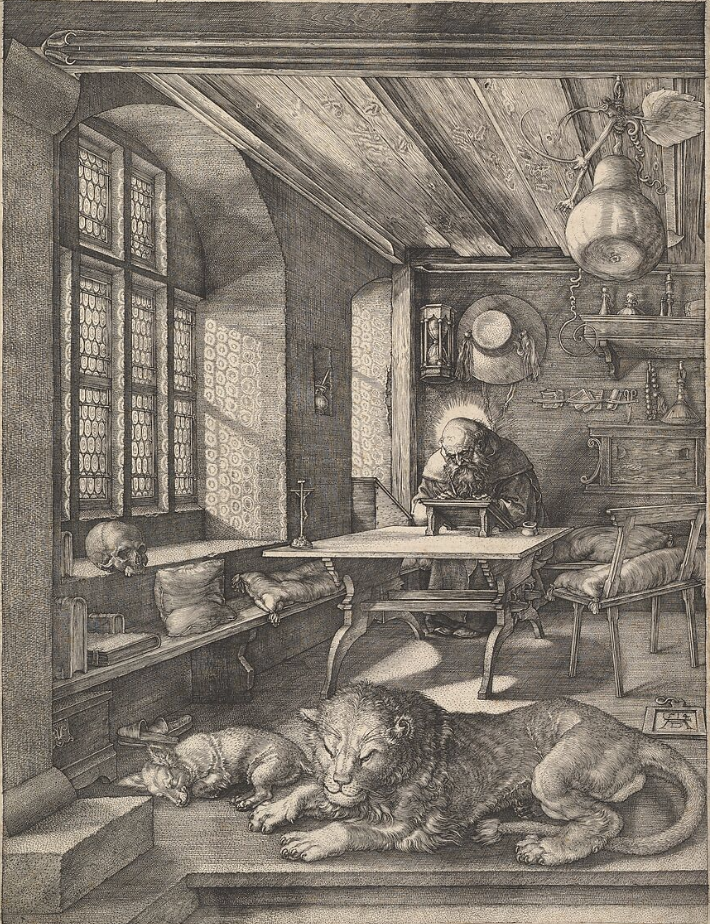
St. Jerome in His Study
Albrecht Durer was a well-known and highly regarded artist of the Northern Renaissance period. His works were numerous and varied widely from portraits, landscapes, architecture, religious work, woodcuts, and copper engravings. He was born on 21 May 1471 and was the second son of a successful goldsmith. His career began as a goldsmith learning in his father’s workshop. At the age of thirteen his immense talent was showcased by a self-portrait as a piece done a year later in 1486 entitled “Madonna with Musical Angels.” Realizing his potential Durer, the elder, arranged for his son to be apprenticed to Michael Wolgemut, he then began his apprenticeship as a woodcut illustrator in the printing business. Studying under Wolgemut Durer honed his mastery of woodcuts, engravings and the newly discovered etching techniques of the day as well as toned paper and canvas.
In 1494 Durer married Agnes Frey, the daughter of a merchant and shortly thereafter he made his first trip to Italy. During this period, he created landscapes in watercolor that were uncanny for the compositional values, broad strokes and amazing harmonization details. His work reflected the influence of Antonio Pollaiuolo and Andrea Mantegna. Pollaiuolo displayed the human body with energetic lines while Mantegna’s classical themes were created with linear articulation of the human body. During Durer’s second trip to Italy in the early 1500’s he nurtured his interest in the Venetian artist Giovanni Bellini. Producing paintings that reflected Bellini’s sweet soft portrait types, his works during this time reflected great mastery and close attention to detail.
During 1513 and 1514 while in his native country Durer created what is believed to be his greatest copperplate engravings: Melancholia I, St. Jerome in His Study, and Knight Death and Devil. All are about the same size of 24.5 X 19.1 cm. (9X7.5 inches). According to scholars the set is to be viewed together. Each has a sense of rich classic perfection attesting to Durer’s highest level of artistic intensity. St. Jerome in His Study is part of a group of three very popular philosophical ideas of the day recognized in medieval time. Knight Death and the Devil belonged to the moral sphere and the “active life”, Melancholia I represents the “intellectual life,” while St. Jerome is the theological and “contemplative life.”
St. Jerome is best known for his translation of the Greek Testament into Latin and was also a favored subject for medieval artists. He is often represented in art as one of the four Doctors of the church, portrayed anachronistically in the garb of a cardinal and depicted as an intensely religious recluse who had a vision that lead him to devote himself to God.
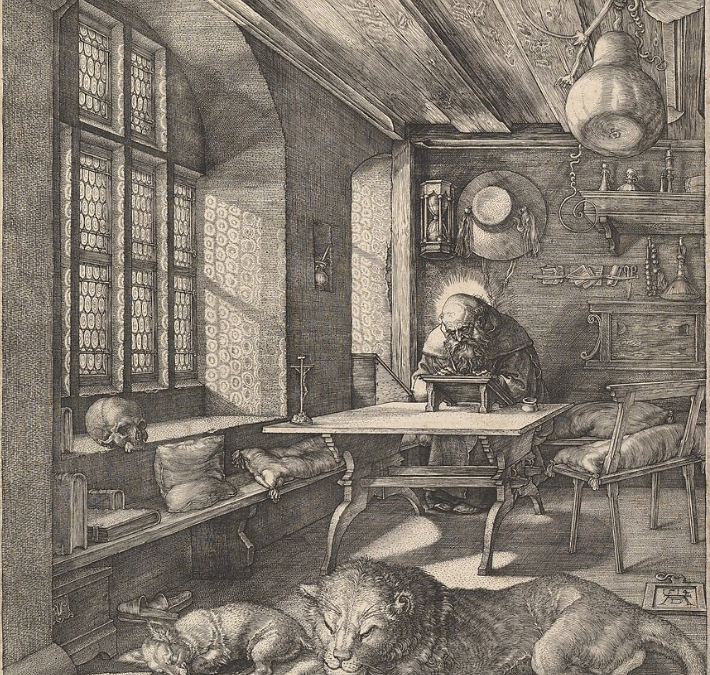
The masterpiece of the engraving cannot be over stated. Durer depicts an intimate moment in the saint’s life where he is engrossed in translating the Bible for the masses. The crucifix on the corner is reference to his Divine appointment. Behind the saint’s head is the ever-present hourglass indicating lapse of time and next to the hourglass is the cardinal’s hat, a reference to St. Jerome’s papal appointment. The Saint’s head is in line with the skull beneath the window as if to speak of his human mortality.
The room is peaceful, yet disorderly and there is a sense of diligent study. The light entering the study is expressed and one can feel and see the light flickering through out the room giving the effect of being in peace and in the presence of the Divine. The light causes beautiful shadows on the floor, walls and even the ceiling producing St. Jerome’s halo. There is so much attention to detail that the pattern of the glass window is reflected on the wall. Below the writing desk the lion which is often an integral story attached to the saint. The lion guards the entrance assuring St. Jerome will have quiet and solitude while he is working. And finally the image of the dog was probably included to symbolize loyalty and faithfulness but also was one of Durer’s recurring themes in his paintings.
The off centered image of St. Jerome adds to the illusion of viewing a moment in time where the perspective of the viewer is not so clear and the feeling of intruding on the monk’s Divine work. But it is this very position that allows the artwork to be cathartic in nature. According to Aristotle “good art allows an individual to release pent up emotions resulting in the feeling of freshness and renewal.” (mod10sec11) although catharsis is always applied to the pathos of a play applied to other emotional states that evoke or compel people to calm something that is simply restorative to the soul. (mod10sec11). Clearly Durer’s artwork evokes a feeling of peacefulness and Divine presence. The spectators experience the transcription of God’s knowledge and are allowed to partake on the fact that the ultimate source of all worldly beauty is from the Divine.
By depicting St. Jerome as he did, Durer was able to accomplish the purpose and goal of human life, which according to Ficini’s philosophical idea is to come to the knowledge and love of God. Ficini who was the most influential philosopher of the 1400’s believed that “humans occupy the middle realm as we are both physical and spiritual beings: our goals is to transcend our physical nature and ascend toward the pure spiritual realm of an angelic mind and ultimate communion with God” (mod11sec9). Durer depicted St. Jerome aiding God by bringing his conversation via the Bible to the masses so they too could transcend to the spiritual realm. Durer was able to portray this Divine peace and serenity thru this beautiful copper engraving with attention to detail devoid of color.
Durer purposefully depicted St. Jerome working as a black and white engraving in order to force the observer’s attention on St. Jerome activity. Aretino mentions that a good painter has the ability to master invention, design and coloring. Durer was able to accomplish these results with the beautiful play of light, texture and design. St. Jerome is exquisitely represented with soft lines that give the impression of a person hunching over the desk. Durer’s devotion to learning how to represent the human figure culminated in his engraving by showcasing his skills in representing the human figure on a copper engraving; he was able to give the illusion of a brightly lit room producing the impression of the saint full body, imitated the flickering of light, the fur of the lion and the dog, the coarseness of the robe, skin and other details without the use of color, yet one can “see and feel” the brightness in the room.
As a result the spectator is made to focus on appreciating St. Jerome’s commitment to translate the Bible in order to provide God’s word to all. I like to think that 600 years later without the knowledge of the philosophical ideas of that time or today, one can ponder upon this work of art and still get a sense of Divine space that compels the spectator to be a little more like St. Jerome and seek the knowledge of God regardless of which denomination the viewer belongs to. The copper engraving still produces awe and touches one’s soul transcending time and space therefore, in my humble opinion, making Durer one of the greatest artists of the Northern Renaissance.
Master's Degree: Fine Art
Course: Sacred Geometry Course Essay