Keepers Of The Threshold: Part 3

Keepers Of The Threshold: Part 3

In this sense, the art is not commentary; it is practice. It trains the psyche to hold what it sees. What began as interpretation gradually became orientation; the symbols no longer remained on the page or canvas, but began to shape how I listened, waited, and chose.

When myth becomes destructive, the symbol must slow it down. The crow initiates: the owl contains; the moon remembers. The painting performs wisdom’s interruption in the register of image.

Modern life often reenacts Lamech in new clothes—certainty armed with technology, escalation rewarded by attention. The remedy is not louder force; it is deeper form. Art becomes symbolic containment: a vessel where intensity can be held without being weaponized.

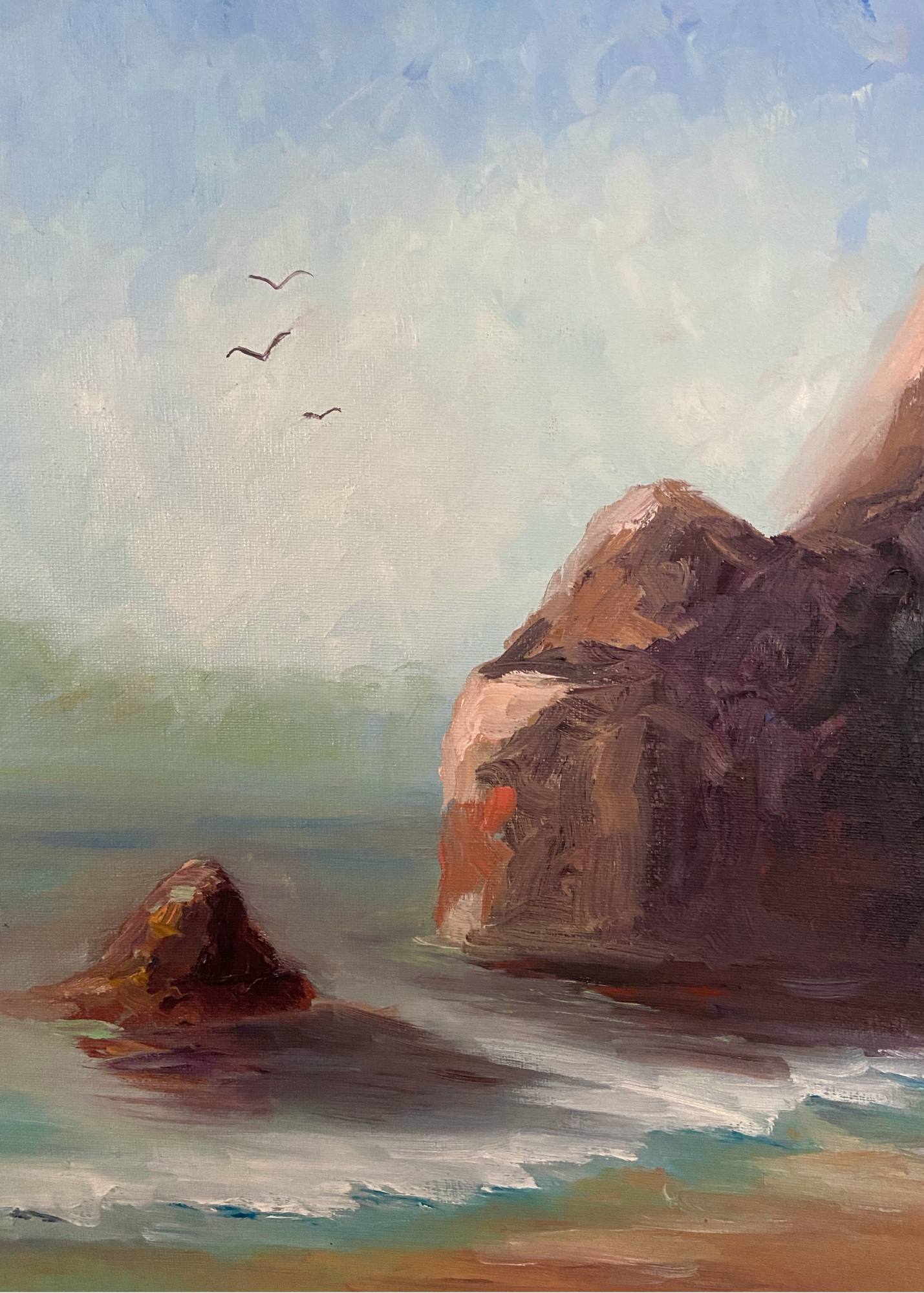
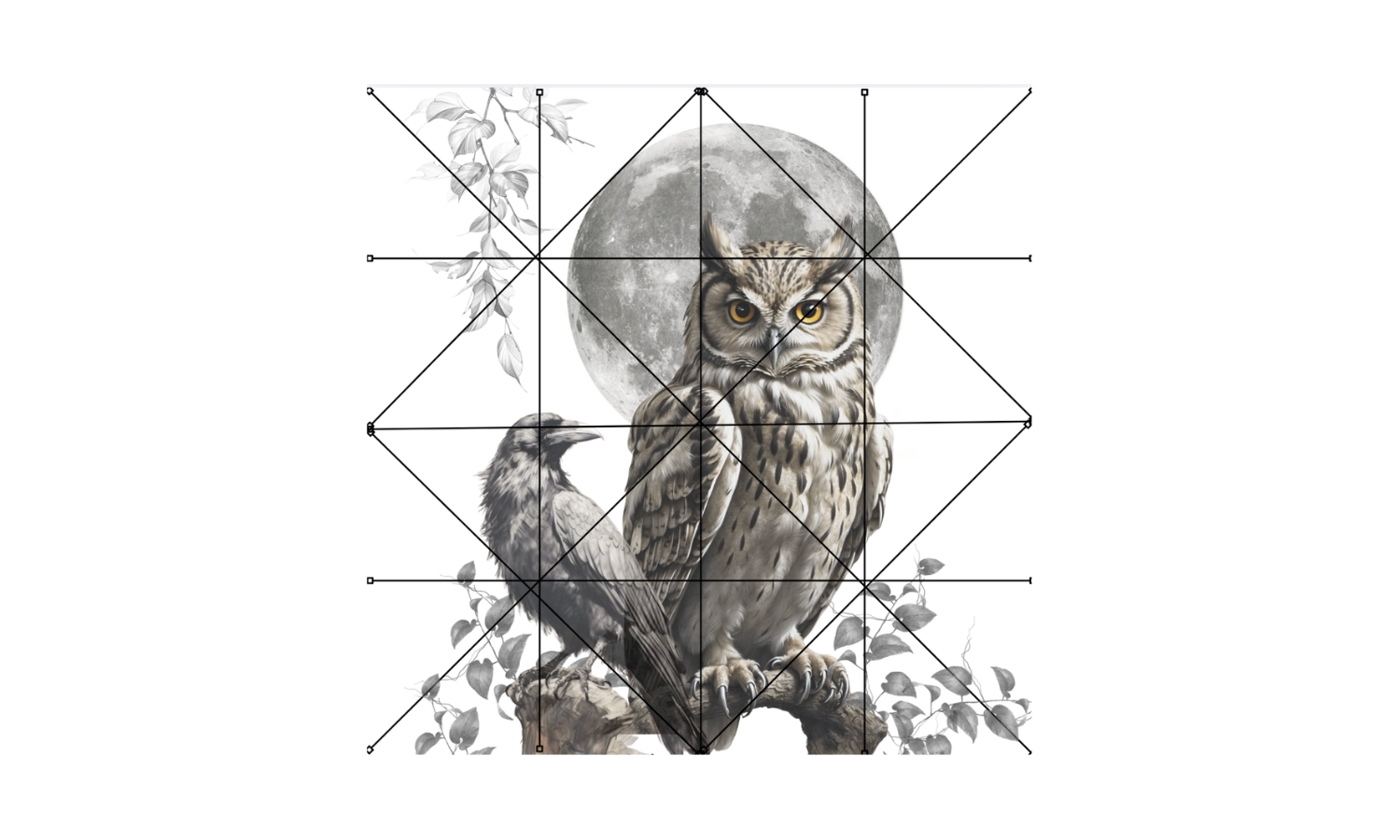
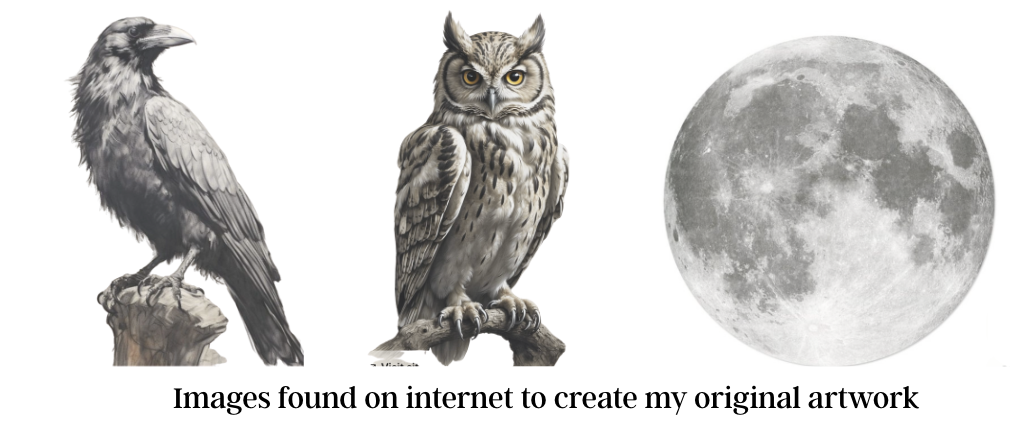
My painting of the crow before a luminous moon, with owl, is a map of that containment. The crow is the threshold messenger, shadow made visible—the first courage to face what is unowned.

The owl is Sophia’s restraint—wisdom after descent, seeing in darkness without panic. The moon is the field—the cyclical time that lets emergence, fullness, and retreat coexist without drama. Taken together, the composition refuses the logic of domination and practices the logic of depth.

Form matters. I work in layered translucency—glazes and washes that allow figures to emerge rather than announce themselves. Edges are softened so that contrast becomes conversation rather than assertion. The image does not explain; it holds.

Within this restraint, the muted color palette offers repose rather than stimulation, and the nocturnal field refuses the fantasy of total clarity. The colors slow perception, granting reflection without possession. “For now, we see through a glass, darkly…” (1 Corinthians 13:12). This dimness is not a deficit but a discipline. The psyche is approached indirectly, with patience and care, until the image yields only what it is ready to reveal. Color functions here not as decoration, but as a regulator of tempo—tempering immediacy, preserving depth, and allowing meaning to ripen rather than be seized.

As Jung insisted, symbols are living presences. Their value lies not in decoding them, but in observing how they arise and what they evoke. In this image, the symbol chooses the medium as much as the medium renders the symbol. The painting is not a solution. It is a way the psyche learns to remain present without becoming force..

Genesis 4 offers a psychological map rather than a moral lecture. It sketches an arc of consciousness as it awakens, wounds, and then boasts.

Abel represents alignment without ego—a posture of offering that does not calculate. Cain introduces the fracture: a wounded ego confronted by unintegrated shadow, unable to hold the discomfort of being seen. Violence emerges there, not as random malice but as the psyche’s defensive maneuver against humiliation and fear. The story intensifies with Lamech. Here meaning detaches from wisdom and fuses with power.

The wound is no longer grieved; it is weaponized and performed. Lamech’s boast—violence justified and then celebrated—names a psychic tipping point: certainty without discernment, escalation without depth. This is the moment when symbolic life turns destructive, when myth’s energy is captured by domination rather than transformation..

In Jungian terms, Lamech is shadow inflation: the ego, unable to bear its injury, expands by force and seeks validation in spectacle. The result is acceleration without integration—more technology, more rhetoric, more speed, but less interiority.

Righteous violence becomes the most dangerous form of chaos because it feels like order. It arrives with clarity, confidence, and a script. What it lacks is wisdom.

Read through the lens of your image, the crow is the first disturbance—the call to individuate and to face the threshold honestly. If that call is refused, the unintegrated material seeks expression elsewhere; it becomes Lamech’s boast.

The antidote is not counter-force but counter-logic: The owl—stillness, listening, discernment—arrives after descent to contain what the crow disclosed. And the moon keeps time for both, reminding us that the psyche ripens in cycles, not in victories.

“Man and His Symbols” does not offer clear answers or universal interpretations. It resists the temptation to turn symbols into formulas.

Instead, it gives something far more valuable: permission to trust personal associations and awareness of how meaning forms internally. Jung’s insistence that “meaning is not universal” reframes interpretation as an act of relationship rather than decoding—a dialogue between image and psyche..

For me, this meant allowing the crow, and moon to speak without forcing them into rigid categories. It meant noticing how their presence stirred questions about shadow, anima, and the rhythms of transformation.

Later, as the owl entered the frame, the work deepened: wisdom as interruption, not domination; containment rather than conquest. These symbols did not arrive as abstractions; they arrived as living presences, shaping both thought and art.

The value of symbols lies not in decoding them, but in observing how they arise and what they evoke within the individual. They do not solve; they invite. They do not argue; they reveal. In that quiet revelation, the psyche finds its own way forward—one image at a time.

What myth names as fate, the Lamech arc names as escalation—a consciousness that speeds up until it breaks. When the world accelerates beyond the soul’s pace, two counterforces appear: Sophia enters as clarity in darkness, and Aphrodite arrives as the ache for beauty that refuses to justify itself.

Wisdom interrupts through insight; beauty interrupts through desire. Art becomes the place where both interruptions can breathe—where seeing and savoring meet, and the human heart remembers how to be at home in its own depths.

The antidote is not counter-force but counter-logic: The owl—stillness, listening, discernment—arrives after descent to contain what the crow disclosed. And the moon keeps time for both, reminding us that the psyche ripens in cycles, not in victories.

“Man and His Symbols” does not offer clear answers or universal interpretations. It resists the temptation to turn symbols into formulas.

Instead, it gives something far more valuable: permission to trust personal associations and awareness of how meaning forms internally. Jung’s insistence that “meaning is not universal” reframes interpretation as an act of relationship rather than decoding—a dialogue between image and psyche..

For me, this meant allowing the crow, and moon to speak without forcing them into rigid categories. It meant noticing how their presence stirred questions about shadow, anima, and the rhythms of transformation.

Later, as the owl entered the frame, the work deepened: wisdom as interruption, not domination; containment rather than conquest. These symbols did not arrive as abstractions; they arrived as living presences, shaping both thought and art.

The value of symbols lies not in decoding them, but in observing how they arise and what they evoke within the individual. They do not solve; they invite. They do not argue; they reveal. In that quiet revelation, the psyche finds its own way forward—one image at a time.

What myth names as fate, the Lamech arc names as escalation—a consciousness that speeds up until it breaks. When the world accelerates beyond the soul’s pace, two counterforces appear: Sophia enters as clarity in darkness, and Aphrodite arrives as the ache for beauty that refuses to justify itself.

Wisdom interrupts through insight; beauty interrupts through desire. Art becomes the place where both interruptions can breathe—where seeing and savoring meet, and the human heart remembers how to be at home in its own depths.

If wisdom speaks softly but cannot be ignored, it is because she is born of night. Sophia is the owl who learns to see without light, the presence that turns confusion into pattern, fear into orientation.

She does not erase shadow; she teaches how to move with it, how to read the undercurrents beneath speech and habit. In moments when life thins to a monotone—when the soul is starved of meaning—Sophia interrupts first as discernment: a sudden inner stillness that separates signal from noise.

Yet insight alone does not restore aliveness. Another interruption arrives, often misread: the rising ache for beauty. Aphrodite has not vanished in modernity; she has been misnamed.

We call her burnout, numbness, dissatisfaction, “something’s missing,” the restless urge to change the room at 2 a.m., the inexplicable pull toward music, gardens, and moonlight. In a culture that prizes productivity over presence, efficiency over savoring, utility over pleasure, there is no language left to welcome her—so her appearance feels like disruption. Beauty is treated as indulgent, desire as trivial or dangerous, pleasure as suspect unless it can produce an invoice..

In this art piece, the owl’s restraint is not mere psychology; it is cosmic order reclaimed. Aphrodite’s radiance in the moon is not ornament but atmosphere—a recovery of eros as sacred rhythm. Together they enact what Paris calls reverence without sentimentality: a posture where insight and desire co-author meaning.

But Aphrodite is aliveness noticing itself. She does not oppose wisdom; she completes it. Where Sophia opens the eyes, Aphrodite opens the body; where Sophia clarifies, Aphrodite vivifies.

Wisdom empties the noise; beauty fills the silence with a pulse. Together they recalibrate time away from acceleration and back toward rhythm—breath, appetite, attention. The interruption, then, is double: to see differently and to savor differently. The soul does not heal by insight alone; it heals when insight invites the senses back to the table.

In the composition, these presences gather: the owl holds Sophia’s gaze—steady, nocturnal, exacting—while the crow keeps watch at the threshold, a reminder that shadow is not an enemy but a guide. Behind and above, the moon offers Aphrodite’s quiet radiance: not ornament, but atmosphere; not romance, but the felt texture of being alive. Branches encircle the scene, suggesting that these forces are not abstract.
Keepers Of The Threshold: Part 2

Keepers Of The Threshold: Part 2

The moonlight provides the receptive field in which this encounter can occur—an atmosphere that allows difficult material to be perceived and metabolized rather than conquered. Within this arrangement, the psyche is supported in moving from a one‑sided identity toward a more whole, psychologically androgynous self—an ego capable of relationship with anima and animus alike, and with the depths from which both arise.

“Everything exposed by the light becomes visible” (Ephesians 5:13) finds resonance here—not as exposure through force, but as revelation without violence, clarity without conquest. This image arrived not as an abstraction, but as a living symbol—one that asks to be approached through attentiveness rather than decoded through control. When the crow and key appear, I do not drive it away. When the owl joins it, I do not turn away from wisdom. And when the moon rises, I allow its quiet light to soften certainty. In their shared presence, an inner practice becomes visible: honoring cycles, meeting darkness with curiosity, and allowing transformation to occur where image and feeling converge.

This is the work of individuation—an ongoing rhythm of descent and return, confrontation and embrace—through which the psyche gradually finds a more balanced, integrated form of life. As Jung reminds us, “The symbol is the best possible expression for something unknown.” The crow, the owl, the moon, and the quietly waiting key cannot be reduced to ornament or explanation. They are living presences that guard mystery—and, for those willing to pause and see, they open the way inward.

When this discipline of indirect seeing is lost, the psyche does not become clearer—it becomes louder. What has not been patiently witnessed seeks expression elsewhere, often through agitation, fixation, or projection. In the absence of symbolic containment, shadow does not disappear; it multiplies, demanding attention in distorted forms. The refusal of darkness does not produce light—it produces spectacle.

Symbols do not live in theory either; they live in the time we are living. As I began reading the 2nd assigned book: “Pagan Meditations” by Ginette Paris: in conjunction with Carl Jung’s book, the artwork began to feel like a response to the culture around me—an argument for restraint, depth, and seeing.

The Hero within lies in our own creative power. We don’t need to slay monsters; we must instead integrate them into our lives. Our shadows have been turned into content, productivity, social media chaos all metaphors for inner imbalance.

Monsters live inside each one of us and we battle them alone in solitude because gone are the days when people sat around the fire and talked about symbols, dreams and their meaning. What we refuse to acknowledge in our selves doesn’t vanish; it recedes and takes control from the recesses of the shadow. Every crisis, personal or cultural is the unconscious demanding attention..

“Until you make the unconscious-conscious, it will direct your life, and will call it “fate” ~unknown

Archetypes are now; the warrior is the startup founder who works 18-hour days and slaves to do something good in the world where they see a need or an injustice. The mother goddess is the new wellness influencer selling a retreat of divine femineity or reconnection. The trickster is the influencer who laughs as they expose hypocrisy in the media or with politicians. The enemy is the archetype in our psyche, the shadow we refuse to see.

Modern life has replaced mythic understanding with algo rhythm distraction, data-wisdom, social chaos etc. when life feels meaningless, myth resurfaces to give the world a villain, a hero, a cosmic plot. Myth was how we broke free of ignorance and now it’s how we are trapped by modern marketing.

We will keep experiencing the things we need to integrate until we understand that every person we love, hate, fear or envy is our teacher. When we stop believing we are separate from the world, we will stop fighting mirrors.

In Psalm 51:6 says: “Surely you desire truth in the inward parts…” God values genuine, deep-down sincerity, integrity, and inner purity (truth in the heart) signifies an unfeigned, core honesty where one's inner self aligns with God's will, contrasting with hypocrisy. If people only understood what this passage means at its core, there would be less suffering in the world and more deep inner work of the self. Wholeness is the path to happiness and success in the external world.

Myth did not vanish; it changed clothes. But the clothes matter less than the body wearing them. If modern life is a stage where archetypes perform in new costumes—productivity as Apollo, wealth disguised as Pluto, hysteria as Dionysus—then we must ask what happens when the performance loses its conscience.

Genesis 4 offers a psychological map rather than a moral lecture. Cain marks the wound that refuses integration; Lamech is that wound amplified and proud. His boast—violence justified, then celebrated—names the peril we face when meaning detaches from wisdom and fuses with power. Before we diagnose the culture, we must see the pattern: escalation without depth. That is the Lamech moment.

If Lamech reveals how consciousness accelerates without depth—certainty hardening into righteous violence—then wisdom appears not as a conqueror but as a quiet refusal. “Above all else, guard your heart” (Proverbs 4:23) is psychological counsel: the center must remain uncolonized by rage.

Truth in the inward parts” (Psalm 51:6) makes the same demand—alignment before action. Even “the kingdom of God is within you” (Luke 17:21) refuses spectacle. Wisdom interrupts escalation by shifting the axis from power to presence, from performance to interiority.

This is owl territory. The owl’s night vision is the capacity to see in darkness without panic; her stillness is listening made form; her restraint is discernment that does not escalate. The owl is Sophia made animal—ordering without domination, receptive without weakness. In Jungian language, this is individuation matured: the psyche no longer seeks victory overshadow but relationship with it.

In the book: “Pagan Meditations” by Ginette Paris gives us a second lens: Paris restores Sophia before demonization, describing a cosmos where logos and eros were companions, not adversaries. This worldview saturates the owl and moon: wisdom as ordering presence, beauty as vivifying pulse. Night, earth, and body are not threats but thresholds.

Paris reminds us that wisdom is relational, not hierarchical—a cosmic order that listens rather than legislates. This principle breathes through the owl’s stillness and the moon’s radiance.

The composition of the crow, owl, and moon makes this logic visible without argument. The crow stands in the foreground—a liminal messenger, the initiator at the shadow threshold.

It breaks the silence and summons courage for descent, echoing the nigredo of alchemical tradition: the necessary dissolution of rigid identifications. The crow is the call to individuation; the psyche’s first disturbance awakes..

As the art piece for my art project approached completion, the crow image seemed to require one final element—subtle, easily overlooked, yet symbolically decisive. A small, muted skeleton key now hangs nearby, present without being offered. It does not promise access or resolution; it marks only the possibility of entry. The key suggests that descent cannot be compelled—it must be chosen. Knowledge here is not granted from without but accessed inwardly through a willingness to look honestly at one’s own life, body, and psychic history. The key belongs to the threshold itself, and it will turn only in the presence of discernment. In this way, the owl’s restraint becomes essential: she holds the encounter steady, ensuring that what emerges from the descent is neither denied nor weaponized.

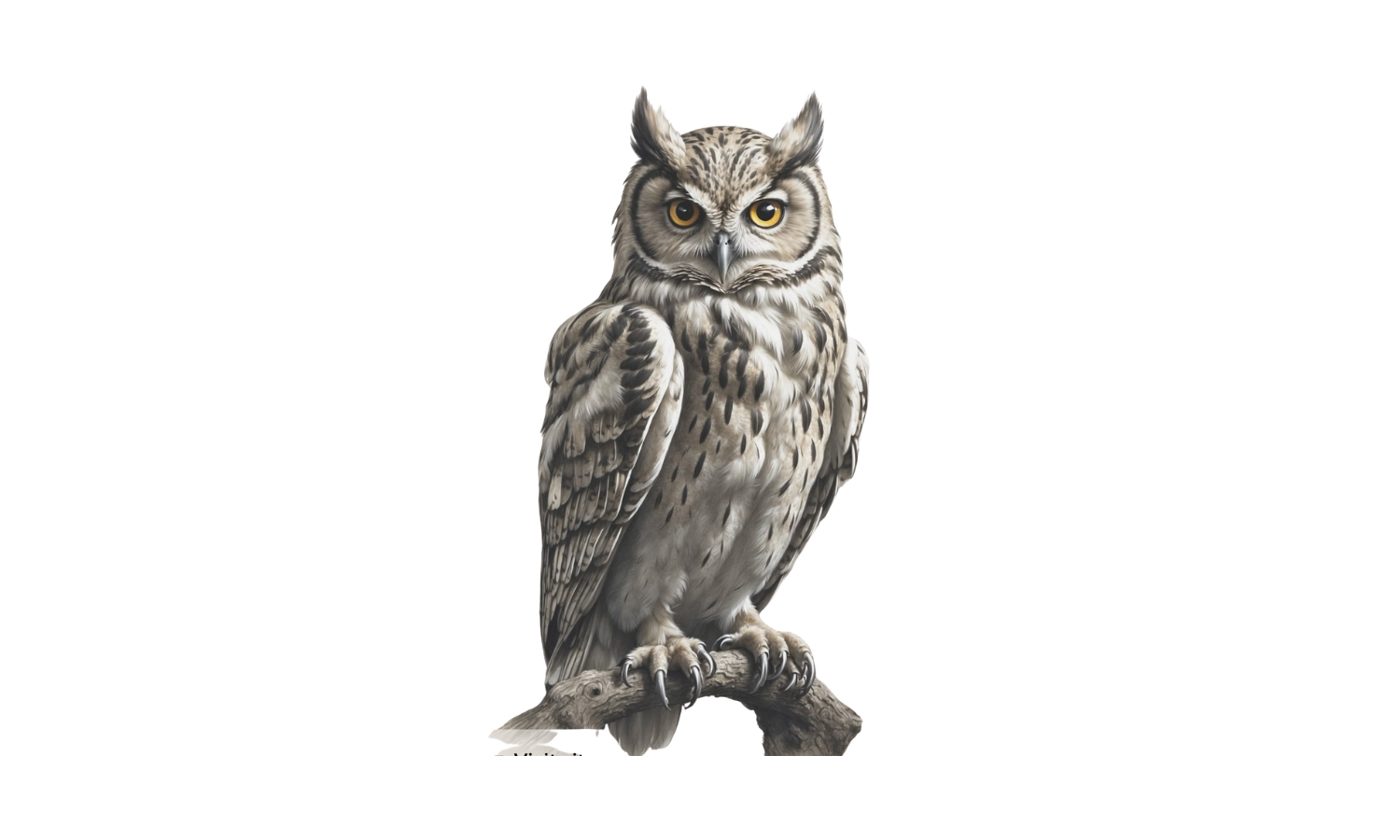
The owl waits in the background, prominent yet still—wisdom after descent, containment without force, discernment without spectacle. She does not advance or retreat; she holds. In this sense, the owl embodies a counter‑Lamech posture: where escalation seeks dominance, she refuses it by remaining present. Her gaze does not fix or accuse; it listens. This wisdom is not passive withdrawal but active restraint—an interruption that does not wound, a depth that resists domination without becoming reactive.

As Sophia, the owl represents a form of knowing that emerges only after the shadow has been faced. She does not abolish darkness; she learns to see within it. Her night vision is the capacity to remain oriented when certainty dissolves, to perceive pattern without forcing resolution. In Jungian terms, this marks individuation matured: the psyche no longer seeks victory over the shadow, but relationship with it. Wisdom here is not conquest or control, but the ability to hold tension without turning it into violence.

Behind them both rises the moon—the unconscious field and keeper of cyclical time, holding the rhythm of death and return that frames encounter and integration. Its light does not conquer shadow but makes it perceptible without violating its depth, creating the conditions for transformation without force. As a feminine symbol, the moon is reflective, intuitive, and rhythmic. Unlike the sun’s analytic glare, lunar illumination reveals by indirection, offering contours rather than conclusions. In Jungian terms, this reflected light describes the way unconscious material enters awareness—not through domination, but through receptivity, imagination, and feeling. Its phases—waxing, fullness, and waning—mirror the psyche’s own movement, reminding us that individuation unfolds in seasons rather than through linear advance.

Placed together, this is not “three symbols,” but sequence held in one frame:

encounter → integration → context larger than both. The symbols disclose psychic truth without argument. The composition itself interrupts Lamech’s boast.

Where violence announces itself, the arrangement of the composition contains it. Where certainty performs, the work listens.

The Room Within: St. Jerome in His Study

The Room Within: St. Jerome in His Study

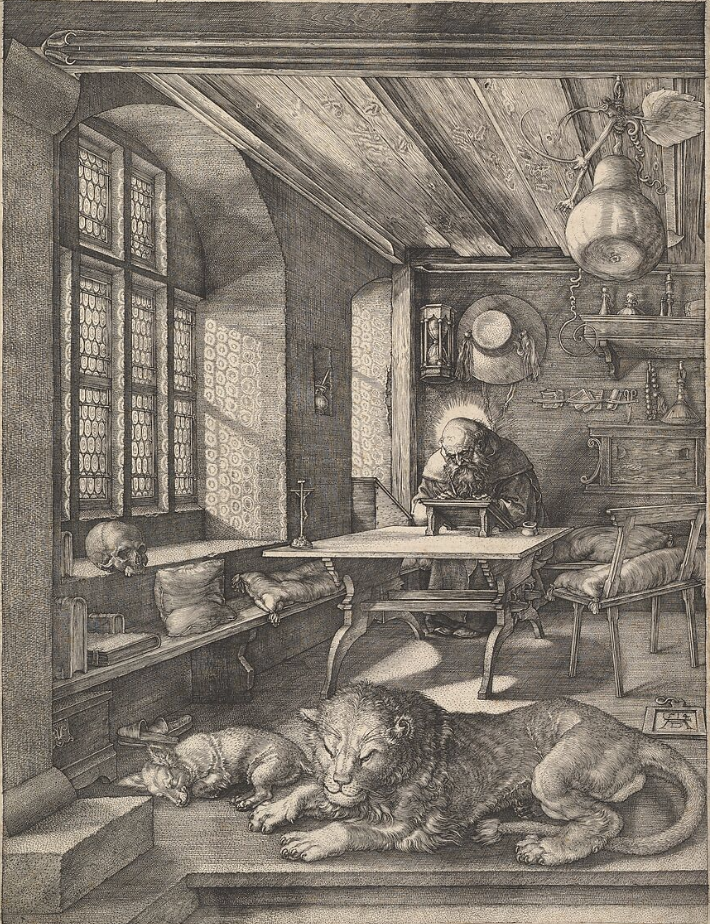
Albrecht Dürer’s St. Jerome in His Study has stayed with me for years; not only as a masterpiece of devotional engraving, but as an image that quietly shaped the atmosphere I longed to live inside: a sacred interior where study, creativity, and peace can coexist.

This reflection grows out of an earlier essay I wrote during my online master’s degree in fine art at the Academy of Art University, San Francisco, for a Sacred Geometry assignment, an experience that first taught me how to speak about art with depth and intention.

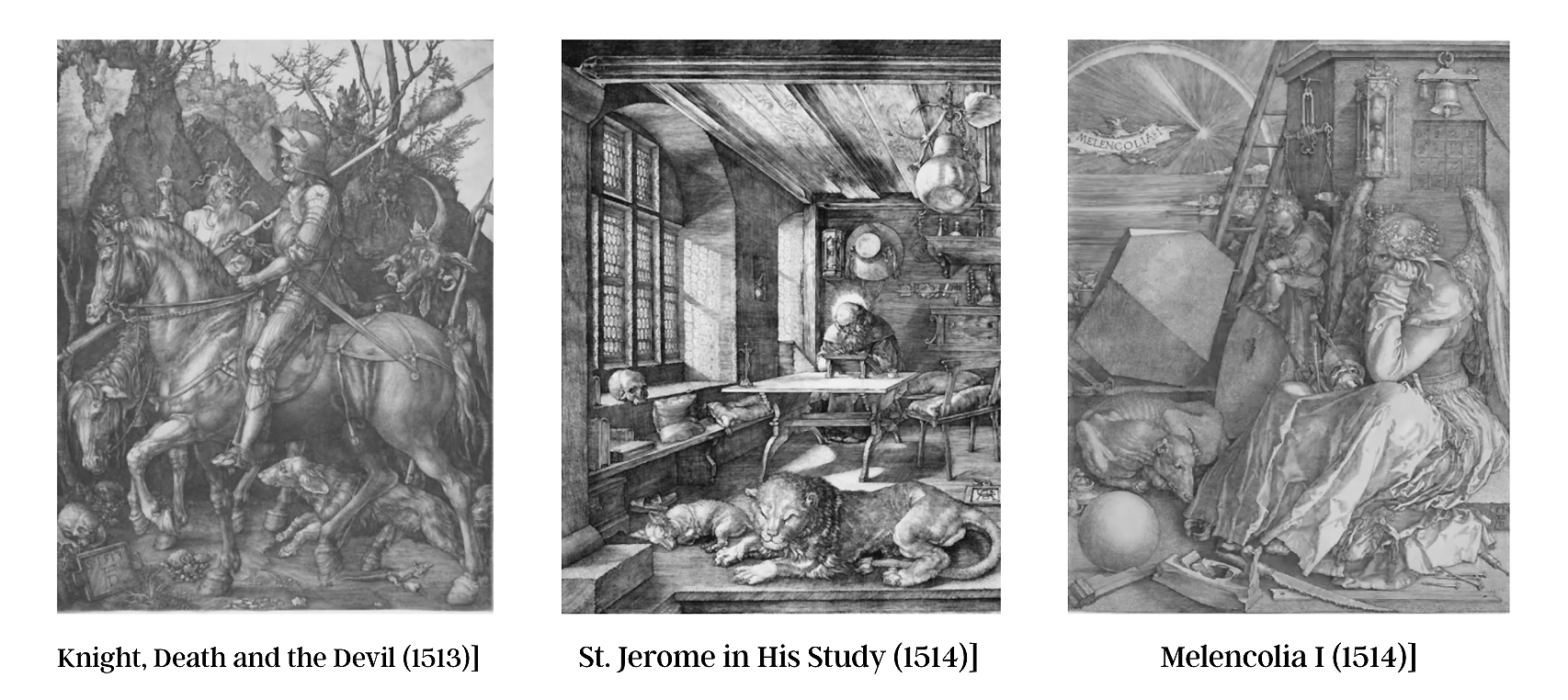
Revisiting that earlier work now through a broader interpretive lens, I return to Dürer’s three Meisterstiche: Knight, Death and the Devil (1513), St. Jerome in His Study (1514), and Melencolia I (1514). A powerful symbolic constellation, yet it is St. Jerome that has remained most deeply with me. I return to it not only as an artwork I once analyzed, but as an image that had already begun shaping my inner life before I had language for “why”, ultimately guiding the creation of my own Bottega, a space built for reflection, art, and the long work of becoming.

Looking back, I can see that I was already seeking what Jung would later help me name as individuation: a way of building an inner room where thought, spirit, imagination, and creative labor could coexist. Durer's engraving did not merely offer subject matter for academic interpretation. It offered an atmosphere, an archetypal feeling of sacred interiority that would continue working on me long after I first encountered it. What I responded to then as beauty and devotion, I now recognize also as psychological form: an image of containment, attention, and meaningful stillness.

The three Meisterstiche still matter here, not because I aim to force them into a single fixed system, but because they provide a larger horizon against which Jerome becomes even more luminous. Knight, Death and the Devil suggests endurance, moral courage, and forward motion through danger. Melencolia I gathers the burden of thought, frustrated making, and the weight of unrealized form. St. Jerome in His Study, by contrast, offers another mode of being: ordered inwardness, disciplined contemplation, and a room sanctified by attention. If the knight presses forward and Melencolia broods in suspension, Jerome dwells.

What interests me now is less the decoding of symbols than the way an image can become a psychic template. I do not mean to claim that Durer consciously encoded a Jungian map of individuation, nor to reduce the engraving to a private projection. Rather, I am interested in how a historically situated devotional image can continue to constellate meaning for a modern viewer, functioning as both artwork and interior guide. In that sense, St. Jerome in His Study has become for me not only an object of study, but a living emblem of the sacred interior I would one day try to build in my own life.

Dürer's three Meisterstiche have long invited comparative reading because each presents a distinct mode of human striving while sharing a density of symbolic suggestion and technical brilliance. Knight, Death and the Devil is often associated with the moral and active life: a mounted figure moving steadily through peril, accompanied by death's hourglass and the monstrous presence of the devil. The image communicates not comfort but resolve. Even before symbolic interpretation, Dürer's command of surface and metal; especially the lustre of the knight's armor against the severe terrain, underscores the engraving's tension between mortal vulnerability and disciplined movement.

St. Jerome in His Study has traditionally been aligned with the theological and contemplative life. Jerome, scholar and translator of the Latin Bible, sits at his desk within an interior arranged for study, prayer, and work. Dürer renders light and shadow across wood, plaster, stone, cloth, bone, and fur with such fluency that the image itself becomes a meditation on translation: material reality passing through the artist's hand and burin into engraved form. The room is thick with meaningful objects - cardinal's hat, rosary, crucifix, skull, writing materials, and the hanging gourd, each carrying historical and devotional associations while also contributing to a larger atmosphere of ordered inwardness.

Melencolia I has often been read as the intellectual life under strain, and the engraving justifies that reading at every level. A winged figure sits in suspended thought amid a charged array of tools, measuring devices, raw materials, and enigmatic forms. The compass hangs in a hand that is capable but paused. The celebrated polyhedron, magic square, bell, and ladder all suggest order, ambition, and incompletion at once. Durer's astonishing material effects invite close looking, but the image also resists full resolution; it stages a mind surrounded by instruments of making while unable, for the moment, to make.

Read together, these engravings do not need to be reduced to a rigid sequence in order to illuminate one another. They can instead be approached as a symbolic field: disciplined action, burdened intellect, and contemplative dwelling. This broader field matters to my reading because it clarifies why St. Jerome in His Study became the engraving that stayed with me. Among the three, Jerome offers not only struggle or pressure but a lived image of integration - a room in which labor, devotion, intellect, and time are held within a coherent interior form.

At first glance, St. Jerome in His Study appears to offer a serene devotional scene: the scholar-saint absorbed in work, seated within a carefully ordered room, accompanied by the lion of his legend and surrounded by the familiar objects of religious and intellectual life. Yet the engraving's power lies not only in what it depicts, but in what it causes the viewer to feel. Durer's mastery of line, texture, proportion, and light transforms the interior into more than a setting. The room becomes an atmosphere of consciousness.

The space is richly furnished, but it does not feel crowded. It feels inhabited. Every object seems placed within a rhythm of use and meaning: manuscripts, desk, crucifix, rosary, hat, skull, hourglass, and the hanging gourd. Historically, these elements can be read within the iconographic and devotional traditions associated with Jerome, mortality, time, scholarship, ascetic discipline, and translation. Such readings remain valuable. They help us understand how Durer's original viewers may have recognized the saintly identity and moral seriousness of the scene. But even before one names any of these symbols, the engraving communicates something more immediate and less reducible: a sense of concentrated stillness in which study itself becomes a sacred act.

This is where the image opens into psychological and archetypal resonance. In a Jungian frame, St. Jerome in His Study may be understood as a vision of the temenos: a bounded, protected interior in which psychic work can unfold. The room is not merely architectural; it is symbolic containment. It creates the conditions under which thought can deepen, attention can settle, and spirit can be joined to labor. Jerome is not shown in dramatic ecstasy or heroic struggle. He is shown in disciplined presence.. The holiness of the engraving lies not in spectacle, but in the sanctification of sustained attention.

What moved me so deeply in this engraving, even before I could articulate it, was precisely this feeling of inward order. I did not encounter the image only as a historical object or a religious illustration. I encountered it as a room I recognized before I had ever built it: a place where intellect, devotion, solitude, and material life were not opposed but gathered together. Looking back, I can see that I was already reaching toward that kind of interiority in my own life - already seeking, without yet naming it, a form of individuation. The engraving gave shape to a longing that was both spiritual and creative: the desire for a space where the psyche could work in peace.

The symbolic force of Jerome's study also extends beyond formal religious interpretation into a broader contemplative and esoteric imagination. Without claiming direct lineage or influence, one can feel in the engraving resonances with traditions that value interior knowledge, hidden ripening, and illumination within enclosure. Light enters the room not as theatrical revelation but as a steady condition of presence. Time is marked not abstractly but concretely, through the hourglass and the rhythm of work. Mortality appears not as panic, but as companion to seriousness. The room holds these tensions: time and timelessness, labor and silence, death and meaning; without collapse. In that sense, Jerome's study becomes an image not merely of scholarship, but of integration.

For me, this engraving eventually ceased to be only a subject of interpretation and became a model of atmosphere. I did not want to replicate Dürer’s room literally; I wanted to recreate its feeling—a sacred, secret place where study, art, reflection, and ordinary life could coexist joyfully. That desire later took form in La Bottega Loft, my art room, shaped as much by the inward stillness I find in Jerome as by the laboring intensity I associate with Michelangelo. My Bottega also carries my painterly lineage: Michelangelo’s studies and discipline, Sargent’s light, and Bouguereau’s devotion to form: each one a guide in how to see, build, and refine. If Dürer gave me the image of contemplative interiority, Michelangelo gives me the energy of fierce making. My Bottega lives between those poles: a place of quiet study and devotional work, but also of effort, experimentation, and embodied creation. In this way, St. Jerome in His Study did more than inspire admiration, it helped shape my life through the making of my own creative space.

What I now understand more clearly is that the engraving functioned for me as a psychic template before it functioned as a fully articulated theory. I was drawn to it because it pictured a way of being I needed: inwardly ordered, spiritually serious, materially grounded, and creatively alive. In that sense, the image worked not only as an object to interpret but as an imaginal pattern to inhabit.

A Jungian reading helps name this process without exhausting it. The temenos is not simply a symbolic room in the artwork; it is also the inner and outer condition required for meaningful work of the psyche. To create such a space is already to participate in individuation. It is to gather scattered energies, establish boundaries, and make room for sustained attention. Jerome's study models this rhythm through ordinary things: desk, books, tools, light, timekeeping, animal presence, all held in a disciplined, livable form.

This is one reason the image has remained active in me across time. It did not stay confined to art history or devotional iconography. It migrated into desire, into habit, and eventually into space-making. The engraving's deepest instruction was not merely symbolic interpretation but form: how to build conditions in which thought, reflection, and creation can ripen.

La Bottega Loft emerged from a longing that I can now trace back to my encounter with Jerome's study. I wanted my art room to feel like a sacred, secret place - peaceful and joyful, a place where I could study, create, and simply be, including with my pets nearby. This was never about reproducing Durer's room literally. It was about recreating an atmosphere: quiet concentration, beauty, containment, and permission to dwell.

At the same time, my Bottega also carries another artistic current: Michelangelo. If Jerome gives me contemplative interiority, Michelangelo gives me muscular labor, intensity, and the sense that making itself can be devotional. In my imagination, the room holds both energies. It is a sanctuary for reflection and a workshop for effort. It invites silence, but it also welcomes struggle, experimentation, and the physicality of art-making.

Seen this way, La Bottega Loft is not only a studio; it is a lived continuation of an image. What began as admiration for an engraving became an interior aspiration, then a concrete environment. The room itself becomes part of the essay's argument: that certain artworks do not simply represent meaning, but generate it in the life of the viewer.

Returning to Durer's Meisterstiche now, I no longer experience them only as historical masterpieces to be decoded. I experience them as living images that continue to work on the psyche. Knight, Death and the Devil, Melencolia I, and St. Jerome in His Study each hold a different mode of human struggle and aspiration, but it is Jerome's room that has remained my deepest teacher. It offered me, long before I could name it, an imaginal form of inward order.

Original St. Jerome Essay

Original St. Jerome Essay

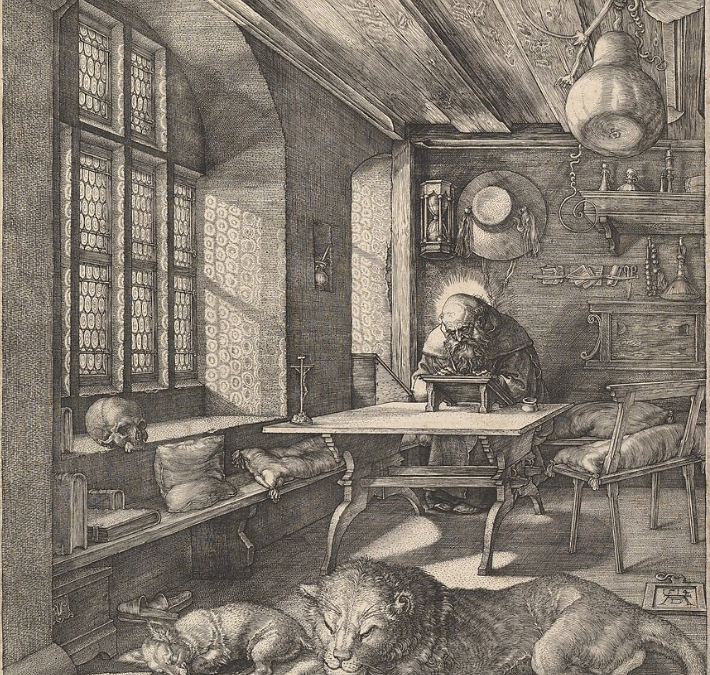
St. Jerome in His Study

Albrecht Durer was a well-known and highly regarded artist of the Northern Renaissance period. His works were numerous and varied widely from portraits, landscapes, architecture, religious work, woodcuts, and copper engravings. He was born on 21 May 1471 and was the second son of a successful goldsmith. His career began as a goldsmith learning in his father’s workshop. At the age of thirteen his immense talent was showcased by a self-portrait as a piece done a year later in 1486 entitled “Madonna with Musical Angels.” Realizing his potential Durer, the elder, arranged for his son to be apprenticed to Michael Wolgemut, he then began his apprenticeship as a woodcut illustrator in the printing business. Studying under Wolgemut Durer honed his mastery of woodcuts, engravings and the newly discovered etching techniques of the day as well as toned paper and canvas.

In 1494 Durer married Agnes Frey, the daughter of a merchant and shortly thereafter he made his first trip to Italy. During this period, he created landscapes in watercolor that were uncanny for the compositional values, broad strokes and amazing harmonization details. His work reflected the influence of Antonio Pollaiuolo and Andrea Mantegna. Pollaiuolo displayed the human body with energetic lines while Mantegna’s classical themes were created with linear articulation of the human body. During Durer’s second trip to Italy in the early 1500’s he nurtured his interest in the Venetian artist Giovanni Bellini. Producing paintings that reflected Bellini’s sweet soft portrait types, his works during this time reflected great mastery and close attention to detail.

During 1513 and 1514 while in his native country Durer created what is believed to be his greatest copperplate engravings: Melancholia I, St. Jerome in His Study, and Knight Death and Devil. All are about the same size of 24.5 X 19.1 cm. (9X7.5 inches). According to scholars the set is to be viewed together. Each has a sense of rich classic perfection attesting to Durer’s highest level of artistic intensity. St. Jerome in His Study is part of a group of three very popular philosophical ideas of the day recognized in medieval time. Knight Death and the Devil belonged to the moral sphere and the “active life”, Melancholia I represents the “intellectual life,” while St. Jerome is the theological and “contemplative life.”

St. Jerome is best known for his translation of the Greek Testament into Latin and was also a favored subject for medieval artists. He is often represented in art as one of the four Doctors of the church, portrayed anachronistically in the garb of a cardinal and depicted as an intensely religious recluse who had a vision that lead him to devote himself to God.

The masterpiece of the engraving cannot be over stated. Durer depicts an intimate moment in the saint’s life where he is engrossed in translating the Bible for the masses. The crucifix on the corner is reference to his Divine appointment. Behind the saint’s head is the ever-present hourglass indicating lapse of time and next to the hourglass is the cardinal’s hat, a reference to St. Jerome’s papal appointment. The Saint’s head is in line with the skull beneath the window as if to speak of his human mortality.

The room is peaceful, yet disorderly and there is a sense of diligent study. The light entering the study is expressed and one can feel and see the light flickering through out the room giving the effect of being in peace and in the presence of the Divine. The light causes beautiful shadows on the floor, walls and even the ceiling producing St. Jerome’s halo. There is so much attention to detail that the pattern of the glass window is reflected on the wall. Below the writing desk the lion which is often an integral story attached to the saint. The lion guards the entrance assuring St. Jerome will have quiet and solitude while he is working. And finally the image of the dog was probably included to symbolize loyalty and faithfulness but also was one of Durer’s recurring themes in his paintings.

The off centered image of St. Jerome adds to the illusion of viewing a moment in time where the perspective of the viewer is not so clear and the feeling of intruding on the monk’s Divine work. But it is this very position that allows the artwork to be cathartic in nature. According to Aristotle “good art allows an individual to release pent up emotions resulting in the feeling of freshness and renewal.” (mod10sec11) although catharsis is always applied to the pathos of a play applied to other emotional states that evoke or compel people to calm something that is simply restorative to the soul. (mod10sec11). Clearly Durer’s artwork evokes a feeling of peacefulness and Divine presence. The spectators experience the transcription of God’s knowledge and are allowed to partake on the fact that the ultimate source of all worldly beauty is from the Divine.

By depicting St. Jerome as he did, Durer was able to accomplish the purpose and goal of human life, which according to Ficini’s philosophical idea is to come to the knowledge and love of God. Ficini who was the most influential philosopher of the 1400’s believed that “humans occupy the middle realm as we are both physical and spiritual beings: our goals is to transcend our physical nature and ascend toward the pure spiritual realm of an angelic mind and ultimate communion with God” (mod11sec9). Durer depicted St. Jerome aiding God by bringing his conversation via the Bible to the masses so they too could transcend to the spiritual realm. Durer was able to portray this Divine peace and serenity thru this beautiful copper engraving with attention to detail devoid of color.

Durer purposefully depicted St. Jerome working as a black and white engraving in order to force the observer’s attention on St. Jerome activity. Aretino mentions that a good painter has the ability to master invention, design and coloring. Durer was able to accomplish these results with the beautiful play of light, texture and design. St. Jerome is exquisitely represented with soft lines that give the impression of a person hunching over the desk. Durer’s devotion to learning how to represent the human figure culminated in his engraving by showcasing his skills in representing the human figure on a copper engraving; he was able to give the illusion of a brightly lit room producing the impression of the saint full body, imitated the flickering of light, the fur of the lion and the dog, the coarseness of the robe, skin and other details without the use of color, yet one can “see and feel” the brightness in the room.

As a result the spectator is made to focus on appreciating St. Jerome’s commitment to translate the Bible in order to provide God’s word to all. I like to think that 600 years later without the knowledge of the philosophical ideas of that time or today, one can ponder upon this work of art and still get a sense of Divine space that compels the spectator to be a little more like St. Jerome and seek the knowledge of God regardless of which denomination the viewer belongs to. The copper engraving still produces awe and touches one’s soul transcending time and space therefore, in my humble opinion, making Durer one of the greatest artists of the Northern Renaissance.

Master's Degree: Fine Art
Course: Sacred Geometry Course Essay