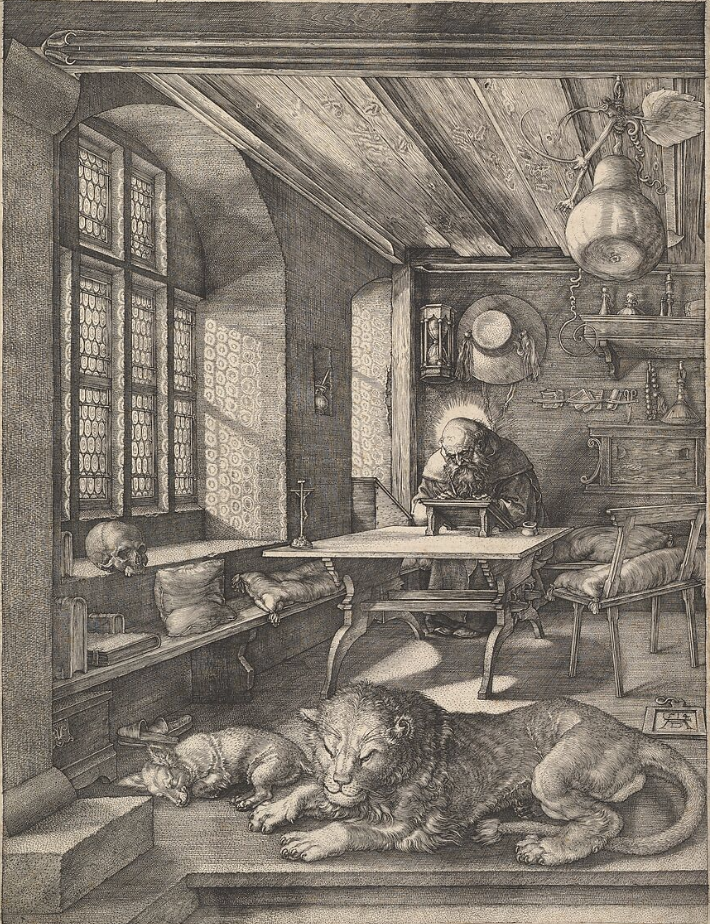
Albrecht Dürer’s St. Jerome in His Study has stayed with me for years; not only as a masterpiece of devotional engraving, but as an image that quietly shaped the atmosphere I longed to live inside: a sacred interior where study, creativity, and peace can coexist.
This reflection grows out of an earlier essay I wrote during my online master’s degree in fine art at the Academy of Art University, San Francisco, for a Sacred Geometry assignment, an experience that first taught me how to speak about art with depth and intention.
Revisiting that earlier work now through a broader interpretive lens, I return to Dürer’s three Meisterstiche: Knight, Death and the Devil (1513), St. Jerome in His Study (1514), and Melencolia I (1514). A powerful symbolic constellation, yet it is St. Jerome that has remained most deeply with me. I return to it not only as an artwork I once analyzed, but as an image that had already begun shaping my inner life before I had language for “why”, ultimately guiding the creation of my own Bottega, a space built for reflection, art, and the long work of becoming.
Looking back, I can see that I was already seeking what Jung would later help me name as individuation: a way of building an inner room where thought, spirit, imagination, and creative labor could coexist. Durer's engraving did not merely offer subject matter for academic interpretation. It offered an atmosphere, an archetypal feeling of sacred interiority that would continue working on me long after I first encountered it. What I responded to then as beauty and devotion, I now recognize also as psychological form: an image of containment, attention, and meaningful stillness.
The three Meisterstiche still matter here, not because I aim to force them into a single fixed system, but because they provide a larger horizon against which Jerome becomes even more luminous. Knight, Death and the Devil suggests endurance, moral courage, and forward motion through danger. Melencolia I gathers the burden of thought, frustrated making, and the weight of unrealized form. St. Jerome in His Study, by contrast, offers another mode of being: ordered inwardness, disciplined contemplation, and a room sanctified by attention. If the knight presses forward and Melencolia broods in suspension, Jerome dwells.
What interests me now is less the decoding of symbols than the way an image can become a psychic template. I do not mean to claim that Durer consciously encoded a Jungian map of individuation, nor to reduce the engraving to a private projection. Rather, I am interested in how a historically situated devotional image can continue to constellate meaning for a modern viewer, functioning as both artwork and interior guide. In that sense, St. Jerome in His Study has become for me not only an object of study, but a living emblem of the sacred interior I would one day try to build in my own life.
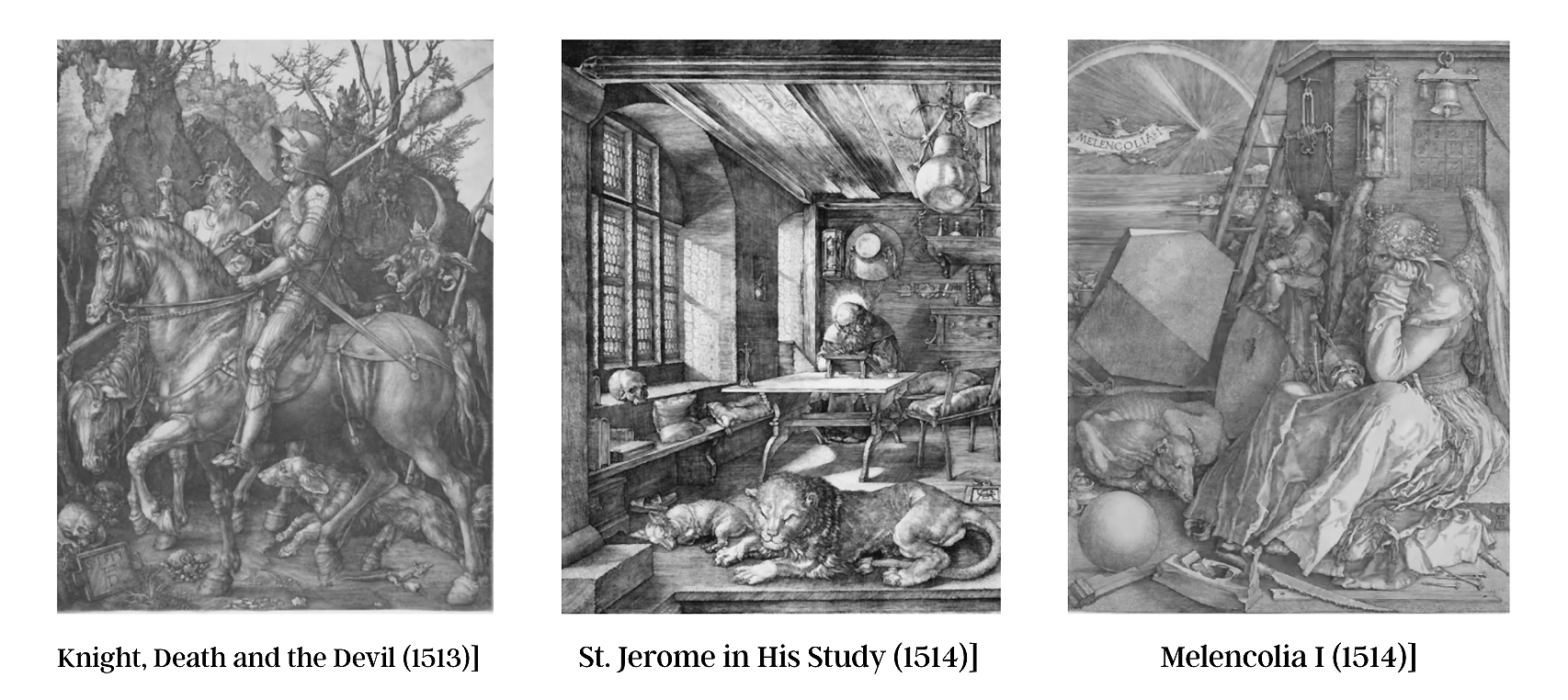
Dürer's three Meisterstiche have long invited comparative reading because each presents a distinct mode of human striving while sharing a density of symbolic suggestion and technical brilliance. Knight, Death and the Devil is often associated with the moral and active life: a mounted figure moving steadily through peril, accompanied by death's hourglass and the monstrous presence of the devil. The image communicates not comfort but resolve. Even before symbolic interpretation, Dürer's command of surface and metal; especially the lustre of the knight's armor against the severe terrain, underscores the engraving's tension between mortal vulnerability and disciplined movement.
St. Jerome in His Study has traditionally been aligned with the theological and contemplative life. Jerome, scholar and translator of the Latin Bible, sits at his desk within an interior arranged for study, prayer, and work. Dürer renders light and shadow across wood, plaster, stone, cloth, bone, and fur with such fluency that the image itself becomes a meditation on translation: material reality passing through the artist's hand and burin into engraved form. The room is thick with meaningful objects - cardinal's hat, rosary, crucifix, skull, writing materials, and the hanging gourd, each carrying historical and devotional associations while also contributing to a larger atmosphere of ordered inwardness.
Melencolia I has often been read as the intellectual life under strain, and the engraving justifies that reading at every level. A winged figure sits in suspended thought amid a charged array of tools, measuring devices, raw materials, and enigmatic forms. The compass hangs in a hand that is capable but paused. The celebrated polyhedron, magic square, bell, and ladder all suggest order, ambition, and incompletion at once. Durer's astonishing material effects invite close looking, but the image also resists full resolution; it stages a mind surrounded by instruments of making while unable, for the moment, to make.
Read together, these engravings do not need to be reduced to a rigid sequence in order to illuminate one another. They can instead be approached as a symbolic field: disciplined action, burdened intellect, and contemplative dwelling. This broader field matters to my reading because it clarifies why St. Jerome in His Study became the engraving that stayed with me. Among the three, Jerome offers not only struggle or pressure but a lived image of integration - a room in which labor, devotion, intellect, and time are held within a coherent interior form.
At first glance, St. Jerome in His Study appears to offer a serene devotional scene: the scholar-saint absorbed in work, seated within a carefully ordered room, accompanied by the lion of his legend and surrounded by the familiar objects of religious and intellectual life. Yet the engraving's power lies not only in what it depicts, but in what it causes the viewer to feel. Durer's mastery of line, texture, proportion, and light transforms the interior into more than a setting. The room becomes an atmosphere of consciousness.
The space is richly furnished, but it does not feel crowded. It feels inhabited. Every object seems placed within a rhythm of use and meaning: manuscripts, desk, crucifix, rosary, hat, skull, hourglass, and the hanging gourd. Historically, these elements can be read within the iconographic and devotional traditions associated with Jerome, mortality, time, scholarship, ascetic discipline, and translation. Such readings remain valuable. They help us understand how Durer's original viewers may have recognized the saintly identity and moral seriousness of the scene. But even before one names any of these symbols, the engraving communicates something more immediate and less reducible: a sense of concentrated stillness in which study itself becomes a sacred act.
This is where the image opens into psychological and archetypal resonance. In a Jungian frame, St. Jerome in His Study may be understood as a vision of the temenos: a bounded, protected interior in which psychic work can unfold. The room is not merely architectural; it is symbolic containment. It creates the conditions under which thought can deepen, attention can settle, and spirit can be joined to labor. Jerome is not shown in dramatic ecstasy or heroic struggle. He is shown in disciplined presence.. The holiness of the engraving lies not in spectacle, but in the sanctification of sustained attention.
What moved me so deeply in this engraving, even before I could articulate it, was precisely this feeling of inward order. I did not encounter the image only as a historical object or a religious illustration. I encountered it as a room I recognized before I had ever built it: a place where intellect, devotion, solitude, and material life were not opposed but gathered together. Looking back, I can see that I was already reaching toward that kind of interiority in my own life - already seeking, without yet naming it, a form of individuation. The engraving gave shape to a longing that was both spiritual and creative: the desire for a space where the psyche could work in peace.
The symbolic force of Jerome's study also extends beyond formal religious interpretation into a broader contemplative and esoteric imagination. Without claiming direct lineage or influence, one can feel in the engraving resonances with traditions that value interior knowledge, hidden ripening, and illumination within enclosure. Light enters the room not as theatrical revelation but as a steady condition of presence. Time is marked not abstractly but concretely, through the hourglass and the rhythm of work. Mortality appears not as panic, but as companion to seriousness. The room holds these tensions: time and timelessness, labor and silence, death and meaning; without collapse. In that sense, Jerome's study becomes an image not merely of scholarship, but of integration.
For me, this engraving eventually ceased to be only a subject of interpretation and became a model of atmosphere. I did not want to replicate Dürer’s room literally; I wanted to recreate its feeling—a sacred, secret place where study, art, reflection, and ordinary life could coexist joyfully. That desire later took form in La Bottega Loft, my art room, shaped as much by the inward stillness I find in Jerome as by the laboring intensity I associate with Michelangelo. My Bottega also carries my painterly lineage: Michelangelo’s studies and discipline, Sargent’s light, and Bouguereau’s devotion to form: each one a guide in how to see, build, and refine. If Dürer gave me the image of contemplative interiority, Michelangelo gives me the energy of fierce making. My Bottega lives between those poles: a place of quiet study and devotional work, but also of effort, experimentation, and embodied creation. In this way, St. Jerome in His Study did more than inspire admiration, it helped shape my life through the making of my own creative space.
What I now understand more clearly is that the engraving functioned for me as a psychic template before it functioned as a fully articulated theory. I was drawn to it because it pictured a way of being I needed: inwardly ordered, spiritually serious, materially grounded, and creatively alive. In that sense, the image worked not only as an object to interpret but as an imaginal pattern to inhabit.
A Jungian reading helps name this process without exhausting it. The temenos is not simply a symbolic room in the artwork; it is also the inner and outer condition required for meaningful work of the psyche. To create such a space is already to participate in individuation. It is to gather scattered energies, establish boundaries, and make room for sustained attention. Jerome's study models this rhythm through ordinary things: desk, books, tools, light, timekeeping, animal presence, all held in a disciplined, livable form.
This is one reason the image has remained active in me across time. It did not stay confined to art history or devotional iconography. It migrated into desire, into habit, and eventually into space-making. The engraving's deepest instruction was not merely symbolic interpretation but form: how to build conditions in which thought, reflection, and creation can ripen.
La Bottega Loft emerged from a longing that I can now trace back to my encounter with Jerome's study. I wanted my art room to feel like a sacred, secret place - peaceful and joyful, a place where I could study, create, and simply be, including with my pets nearby. This was never about reproducing Durer's room literally. It was about recreating an atmosphere: quiet concentration, beauty, containment, and permission to dwell.
At the same time, my Bottega also carries another artistic current: Michelangelo. If Jerome gives me contemplative interiority, Michelangelo gives me muscular labor, intensity, and the sense that making itself can be devotional. In my imagination, the room holds both energies. It is a sanctuary for reflection and a workshop for effort. It invites silence, but it also welcomes struggle, experimentation, and the physicality of art-making.
Seen this way, La Bottega Loft is not only a studio; it is a lived continuation of an image. What began as admiration for an engraving became an interior aspiration, then a concrete environment. The room itself becomes part of the essay's argument: that certain artworks do not simply represent meaning, but generate it in the life of the viewer.
Returning to Durer's Meisterstiche now, I no longer experience them only as historical masterpieces to be decoded. I experience them as living images that continue to work on the psyche. Knight, Death and the Devil, Melencolia I, and St. Jerome in His Study each hold a different mode of human struggle and aspiration, but it is Jerome's room that has remained my deepest teacher. It offered me, long before I could name it, an imaginal form of inward order.