In this sense, the art is not commentary; it is practice. It trains the psyche to hold what it sees. What began as interpretation gradually became orientation; the symbols no longer remained on the page or canvas, but began to shape how I listened, waited, and chose.
When myth becomes destructive, the symbol must slow it down. The crow initiates: the owl contains; the moon remembers. The painting performs wisdom’s interruption in the register of image.
Modern life often reenacts Lamech in new clothes—certainty armed with technology, escalation rewarded by attention. The remedy is not louder force; it is deeper form. Art becomes symbolic containment: a vessel where intensity can be held without being weaponized.
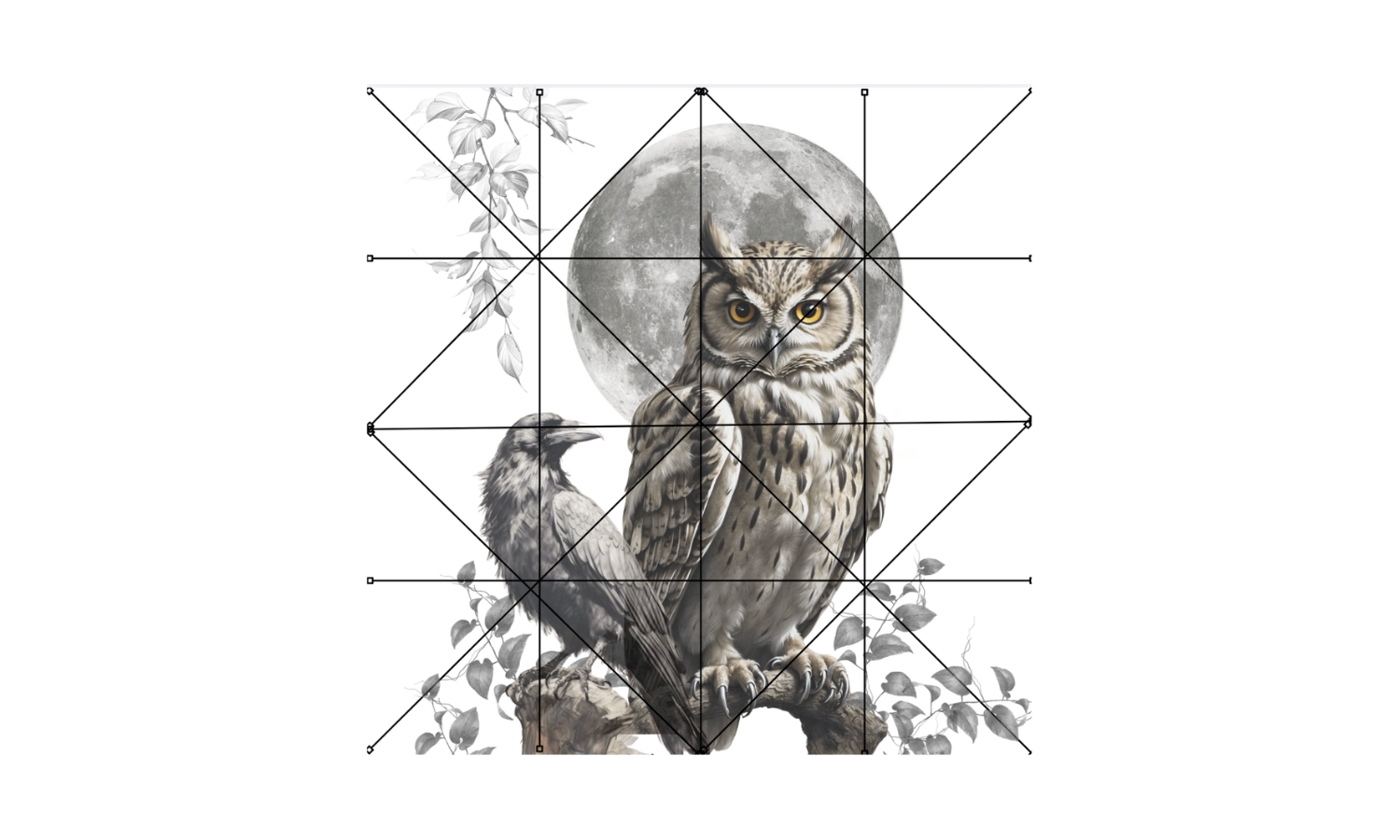
My painting of the crow before a luminous moon, with owl, is a map of that containment. The crow is the threshold messenger, shadow made visible—the first courage to face what is unowned.
The owl is Sophia’s restraint—wisdom after descent, seeing in darkness without panic. The moon is the field—the cyclical time that lets emergence, fullness, and retreat coexist without drama. Taken together, the composition refuses the logic of domination and practices the logic of depth.
Form matters. I work in layered translucency—glazes and washes that allow figures to emerge rather than announce themselves. Edges are softened so that contrast becomes conversation rather than assertion. The image does not explain; it holds.
Within this restraint, the muted color palette offers repose rather than stimulation, and the nocturnal field refuses the fantasy of total clarity. The colors slow perception, granting reflection without possession. “For now, we see through a glass, darkly…” (1 Corinthians 13:12). This dimness is not a deficit but a discipline. The psyche is approached indirectly, with patience and care, until the image yields only what it is ready to reveal. Color functions here not as decoration, but as a regulator of tempo—tempering immediacy, preserving depth, and allowing meaning to ripen rather than be seized.
As Jung insisted, symbols are living presences. Their value lies not in decoding them, but in observing how they arise and what they evoke. In this image, the symbol chooses the medium as much as the medium renders the symbol. The painting is not a solution. It is a way the psyche learns to remain present without becoming force..
Genesis 4 offers a psychological map rather than a moral lecture. It sketches an arc of consciousness as it awakens, wounds, and then boasts.
Abel represents alignment without ego—a posture of offering that does not calculate. Cain introduces the fracture: a wounded ego confronted by unintegrated shadow, unable to hold the discomfort of being seen. Violence emerges there, not as random malice but as the psyche’s defensive maneuver against humiliation and fear. The story intensifies with Lamech. Here meaning detaches from wisdom and fuses with power.
The wound is no longer grieved; it is weaponized and performed. Lamech’s boast—violence justified and then celebrated—names a psychic tipping point: certainty without discernment, escalation without depth. This is the moment when symbolic life turns destructive, when myth’s energy is captured by domination rather than transformation..
In Jungian terms, Lamech is shadow inflation: the ego, unable to bear its injury, expands by force and seeks validation in spectacle. The result is acceleration without integration—more technology, more rhetoric, more speed, but less interiority.
Righteous violence becomes the most dangerous form of chaos because it feels like order. It arrives with clarity, confidence, and a script. What it lacks is wisdom.
Read through the lens of your image, the crow is the first disturbance—the call to individuate and to face the threshold honestly. If that call is refused, the unintegrated material seeks expression elsewhere; it becomes Lamech’s boast.
The antidote is not counter-force but counter-logic: The owl—stillness, listening, discernment—arrives after descent to contain what the crow disclosed. And the moon keeps time for both, reminding us that the psyche ripens in cycles, not in victories.
“Man and His Symbols” does not offer clear answers or universal interpretations. It resists the temptation to turn symbols into formulas.
Instead, it gives something far more valuable: permission to trust personal associations and awareness of how meaning forms internally. Jung’s insistence that “meaning is not universal” reframes interpretation as an act of relationship rather than decoding—a dialogue between image and psyche..
For me, this meant allowing the crow, and moon to speak without forcing them into rigid categories. It meant noticing how their presence stirred questions about shadow, anima, and the rhythms of transformation.
Later, as the owl entered the frame, the work deepened: wisdom as interruption, not domination; containment rather than conquest. These symbols did not arrive as abstractions; they arrived as living presences, shaping both thought and art.
The value of symbols lies not in decoding them, but in observing how they arise and what they evoke within the individual. They do not solve; they invite. They do not argue; they reveal. In that quiet revelation, the psyche finds its own way forward—one image at a time.
What myth names as fate, the Lamech arc names as escalation—a consciousness that speeds up until it breaks. When the world accelerates beyond the soul’s pace, two counterforces appear: Sophia enters as clarity in darkness, and Aphrodite arrives as the ache for beauty that refuses to justify itself.
Wisdom interrupts through insight; beauty interrupts through desire. Art becomes the place where both interruptions can breathe—where seeing and savoring meet, and the human heart remembers how to be at home in its own depths.
The antidote is not counter-force but counter-logic: The owl—stillness, listening, discernment—arrives after descent to contain what the crow disclosed. And the moon keeps time for both, reminding us that the psyche ripens in cycles, not in victories.
“Man and His Symbols” does not offer clear answers or universal interpretations. It resists the temptation to turn symbols into formulas.
Instead, it gives something far more valuable: permission to trust personal associations and awareness of how meaning forms internally. Jung’s insistence that “meaning is not universal” reframes interpretation as an act of relationship rather than decoding—a dialogue between image and psyche..
For me, this meant allowing the crow, and moon to speak without forcing them into rigid categories. It meant noticing how their presence stirred questions about shadow, anima, and the rhythms of transformation.
Later, as the owl entered the frame, the work deepened: wisdom as interruption, not domination; containment rather than conquest. These symbols did not arrive as abstractions; they arrived as living presences, shaping both thought and art.
The value of symbols lies not in decoding them, but in observing how they arise and what they evoke within the individual. They do not solve; they invite. They do not argue; they reveal. In that quiet revelation, the psyche finds its own way forward—one image at a time.
What myth names as fate, the Lamech arc names as escalation—a consciousness that speeds up until it breaks. When the world accelerates beyond the soul’s pace, two counterforces appear: Sophia enters as clarity in darkness, and Aphrodite arrives as the ache for beauty that refuses to justify itself.
Wisdom interrupts through insight; beauty interrupts through desire. Art becomes the place where both interruptions can breathe—where seeing and savoring meet, and the human heart remembers how to be at home in its own depths.
If wisdom speaks softly but cannot be ignored, it is because she is born of night. Sophia is the owl who learns to see without light, the presence that turns confusion into pattern, fear into orientation.
She does not erase shadow; she teaches how to move with it, how to read the undercurrents beneath speech and habit. In moments when life thins to a monotone—when the soul is starved of meaning—Sophia interrupts first as discernment: a sudden inner stillness that separates signal from noise.
Yet insight alone does not restore aliveness. Another interruption arrives, often misread: the rising ache for beauty. Aphrodite has not vanished in modernity; she has been misnamed.
We call her burnout, numbness, dissatisfaction, “something’s missing,” the restless urge to change the room at 2 a.m., the inexplicable pull toward music, gardens, and moonlight. In a culture that prizes productivity over presence, efficiency over savoring, utility over pleasure, there is no language left to welcome her—so her appearance feels like disruption. Beauty is treated as indulgent, desire as trivial or dangerous, pleasure as suspect unless it can produce an invoice..
In this art piece, the owl’s restraint is not mere psychology; it is cosmic order reclaimed. Aphrodite’s radiance in the moon is not ornament but atmosphere—a recovery of eros as sacred rhythm. Together they enact what Paris calls reverence without sentimentality: a posture where insight and desire co-author meaning.
But Aphrodite is aliveness noticing itself. She does not oppose wisdom; she completes it. Where Sophia opens the eyes, Aphrodite opens the body; where Sophia clarifies, Aphrodite vivifies.
Wisdom empties the noise; beauty fills the silence with a pulse. Together they recalibrate time away from acceleration and back toward rhythm—breath, appetite, attention. The interruption, then, is double: to see differently and to savor differently. The soul does not heal by insight alone; it heals when insight invites the senses back to the table.
In the composition, these presences gather: the owl holds Sophia’s gaze—steady, nocturnal, exacting—while the crow keeps watch at the threshold, a reminder that shadow is not an enemy but a guide. Behind and above, the moon offers Aphrodite’s quiet radiance: not ornament, but atmosphere; not romance, but the felt texture of being alive. Branches encircle the scene, suggesting that these forces are not abstract.