Keepers Of The Threshold:Part 4
They root. They leaf. They grow in ordinary time.
To recognize them is to grant that the psyche is not a machine to optimize, but a living ecology to tend. Wisdom interrupts the race; beauty interrupts the dryness. One clears a path; the other makes the path worth walking.
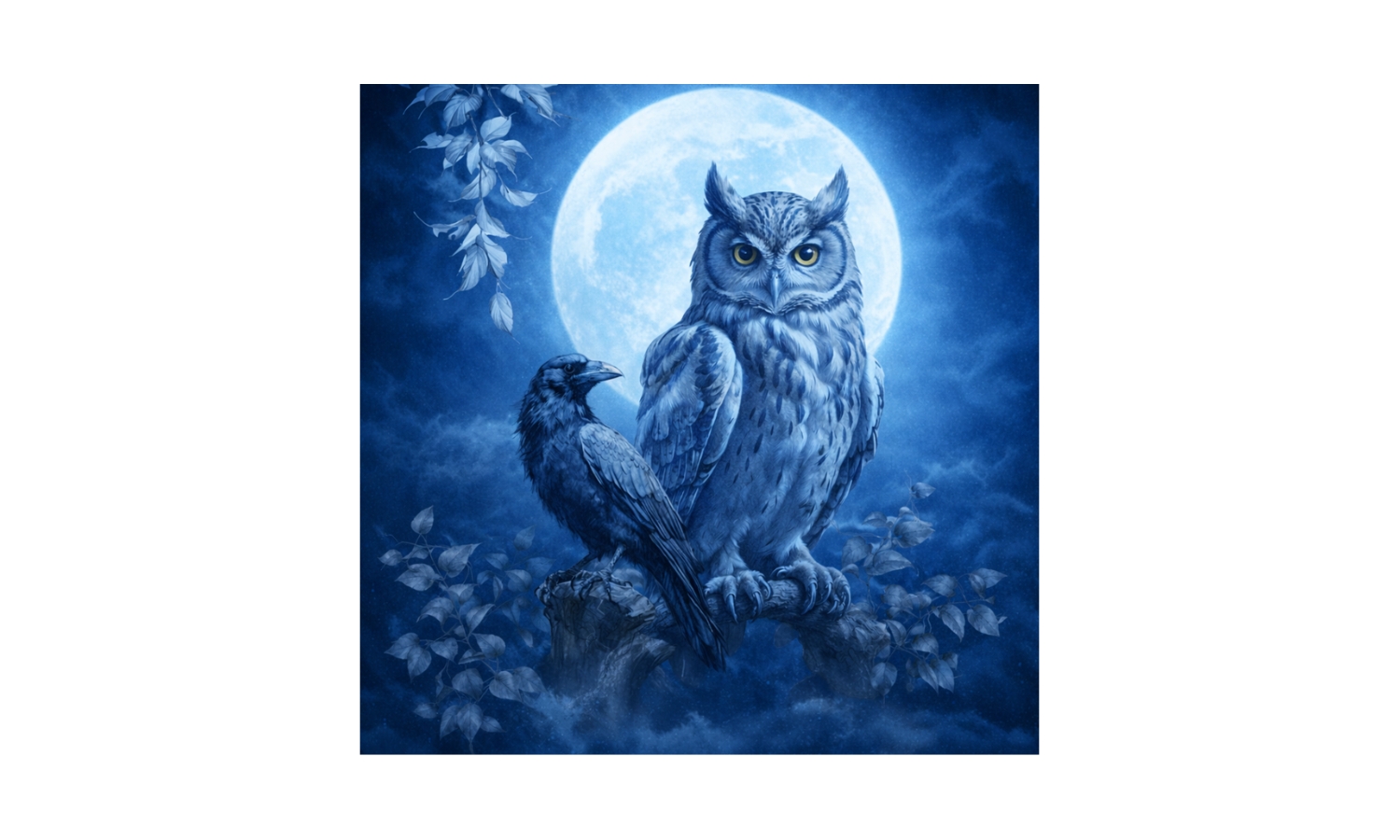
Art is where interruptions learn to live together. The art piece gathers shadow (crow), wisdom (owl/Sophia), and beauty (Aphrodite/moon) into a single field so the psyche can hold paradox without splitting. The crow stands at the limen—alert, inconvenient, honest.
The owl anchors the center—composed, patient, unflinching. The moon becomes the common light—breathing a tender magnitude over both. Around them, branches offer a living frame: growth that touches the scene without closing it, a reminder that even thresholds belong to a larger ecology.
As a container, the image does not resolve conflict; it houses it. Shadow does not cancel wisdom; wisdom does not sterilize desire; beauty does not distract from truth.
Instead, each presence shapes the others: the crow’s severity protects beauty from becoming decoration; the owl’s clarity protects desire from becoming compulsion;
the moon’s radiance protects insight from becoming austerity. This is symbolic equilibrium—not balance as stasis, but balance as breathing.
The planned process matters. Working this composition onto canvas with a charcoal under painting, followed by a dark blue monochromatic under painting and ending with oil glazes on top invites both lucidity and depth—temperance and luxuriance—mirroring Sophia’s clarity and Aphrodite’s richness.
The 16 × 16 square keeps the cosmos intimate—not a distant myth, but a room‑sized invitation to notice, to slow, to feel. As a four‑sided frame, the square functions as earthbound containment, drawing on mandala logic and the psyche’s instinct for quaternity when holding complex inner material. The doubled structure of the 4 × 4 scale reinforces stability and grounded totality, offering a vessel capable of bearing what emerges without dispersal. Within this containment, the work becomes a practice in seeing and savoring: layer by layer, discerning what must be given form and what must remain luminous.
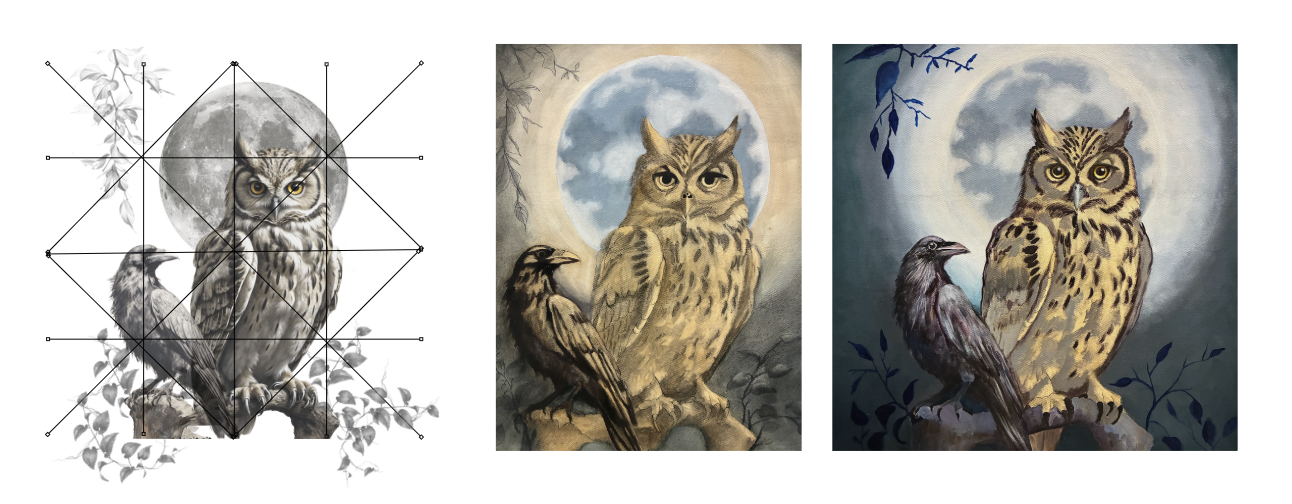
Final Composition: First layer: charcoal painting, 2nd layer: blue monochromatic under painting, and finished painting with a limited colored oil glazes.
What the mind learns from such a container is subtle: that we can endure the owl’s honesty because the moon is kind; that we can approach the crow’s threshold because beauty is already here. In a culture that races past its own life, the image reinstates ritual—a place to pause where meaning and pleasure are both allowed. To stand before it is to remember that wisdom’s task is not only to understand, but to make a home for desire; and that beauty’s task is not only to allure, but to tenderize attention until truth can be welcomed.
Art, then, does what argument cannot: it lets Sophia and Aphrodite inhabit the same sky. It teaches the nervous system that complexity can be held, and that aliveness is not the opposite of insight. I began by looking for archetypal meanings; I ended by letting the symbols make a life with me. The crow is not misfortune; it keeps the gate, feathered discernment. The owl does not explain wisdom; she holds the room. The moon does not promise answers; it keeps time. The small key remains near—present, undecorative, a reminder that entry is chosen.
This is not mastery. It is hospitality. The work taught me to see and to savor—to let image and feeling cohere without haste. Practice replaced spectacle; containment replaced conquest. The square held what arrived. The palette slowed my eyes until patience became form.
If individuation is a rhythm and not a race, then this piece is a way of keeping time. The symbols no longer live only on canvas; they order attention—how I listen, wait, and choose.
Under this moon, the watchers keep the threshold, and the threshold—at last—keeps me.