The moonlight provides the receptive field in which this encounter can occur—an atmosphere that allows difficult material to be perceived and metabolized rather than conquered. Within this arrangement, the psyche is supported in moving from a one‑sided identity toward a more whole, psychologically androgynous self—an ego capable of relationship with anima and animus alike, and with the depths from which both arise.
“Everything exposed by the light becomes visible” (Ephesians 5:13) finds resonance here—not as exposure through force, but as revelation without violence, clarity without conquest. This image arrived not as an abstraction, but as a living symbol—one that asks to be approached through attentiveness rather than decoded through control. When the crow and key appear, I do not drive it away. When the owl joins it, I do not turn away from wisdom. And when the moon rises, I allow its quiet light to soften certainty. In their shared presence, an inner practice becomes visible: honoring cycles, meeting darkness with curiosity, and allowing transformation to occur where image and feeling converge.
This is the work of individuation—an ongoing rhythm of descent and return, confrontation and embrace—through which the psyche gradually finds a more balanced, integrated form of life. As Jung reminds us, “The symbol is the best possible expression for something unknown.” The crow, the owl, the moon, and the quietly waiting key cannot be reduced to ornament or explanation. They are living presences that guard mystery—and, for those willing to pause and see, they open the way inward.
When this discipline of indirect seeing is lost, the psyche does not become clearer—it becomes louder. What has not been patiently witnessed seeks expression elsewhere, often through agitation, fixation, or projection. In the absence of symbolic containment, shadow does not disappear; it multiplies, demanding attention in distorted forms. The refusal of darkness does not produce light—it produces spectacle.
Symbols do not live in theory either; they live in the time we are living. As I began reading the 2nd assigned book: “Pagan Meditations” by Ginette Paris: in conjunction with Carl Jung’s book, the artwork began to feel like a response to the culture around me—an argument for restraint, depth, and seeing.
The Hero within lies in our own creative power. We don’t need to slay monsters; we must instead integrate them into our lives. Our shadows have been turned into content, productivity, social media chaos all metaphors for inner imbalance.
Monsters live inside each one of us and we battle them alone in solitude because gone are the days when people sat around the fire and talked about symbols, dreams and their meaning. What we refuse to acknowledge in our selves doesn’t vanish; it recedes and takes control from the recesses of the shadow. Every crisis, personal or cultural is the unconscious demanding attention..
“Until you make the unconscious-conscious, it will direct your life, and will call it “fate” ~unknown
Archetypes are now; the warrior is the startup founder who works 18-hour days and slaves to do something good in the world where they see a need or an injustice. The mother goddess is the new wellness influencer selling a retreat of divine femineity or reconnection. The trickster is the influencer who laughs as they expose hypocrisy in the media or with politicians. The enemy is the archetype in our psyche, the shadow we refuse to see.
Modern life has replaced mythic understanding with algo rhythm distraction, data-wisdom, social chaos etc. when life feels meaningless, myth resurfaces to give the world a villain, a hero, a cosmic plot. Myth was how we broke free of ignorance and now it’s how we are trapped by modern marketing.
We will keep experiencing the things we need to integrate until we understand that every person we love, hate, fear or envy is our teacher. When we stop believing we are separate from the world, we will stop fighting mirrors.
In Psalm 51:6 says: “Surely you desire truth in the inward parts…” God values genuine, deep-down sincerity, integrity, and inner purity (truth in the heart) signifies an unfeigned, core honesty where one's inner self aligns with God's will, contrasting with hypocrisy. If people only understood what this passage means at its core, there would be less suffering in the world and more deep inner work of the self. Wholeness is the path to happiness and success in the external world.
Myth did not vanish; it changed clothes. But the clothes matter less than the body wearing them. If modern life is a stage where archetypes perform in new costumes—productivity as Apollo, wealth disguised as Pluto, hysteria as Dionysus—then we must ask what happens when the performance loses its conscience.
Genesis 4 offers a psychological map rather than a moral lecture. Cain marks the wound that refuses integration; Lamech is that wound amplified and proud. His boast—violence justified, then celebrated—names the peril we face when meaning detaches from wisdom and fuses with power. Before we diagnose the culture, we must see the pattern: escalation without depth. That is the Lamech moment.
If Lamech reveals how consciousness accelerates without depth—certainty hardening into righteous violence—then wisdom appears not as a conqueror but as a quiet refusal. “Above all else, guard your heart” (Proverbs 4:23) is psychological counsel: the center must remain uncolonized by rage.
“Truth in the inward parts” (Psalm 51:6) makes the same demand—alignment before action. Even “the kingdom of God is within you” (Luke 17:21) refuses spectacle. Wisdom interrupts escalation by shifting the axis from power to presence, from performance to interiority.
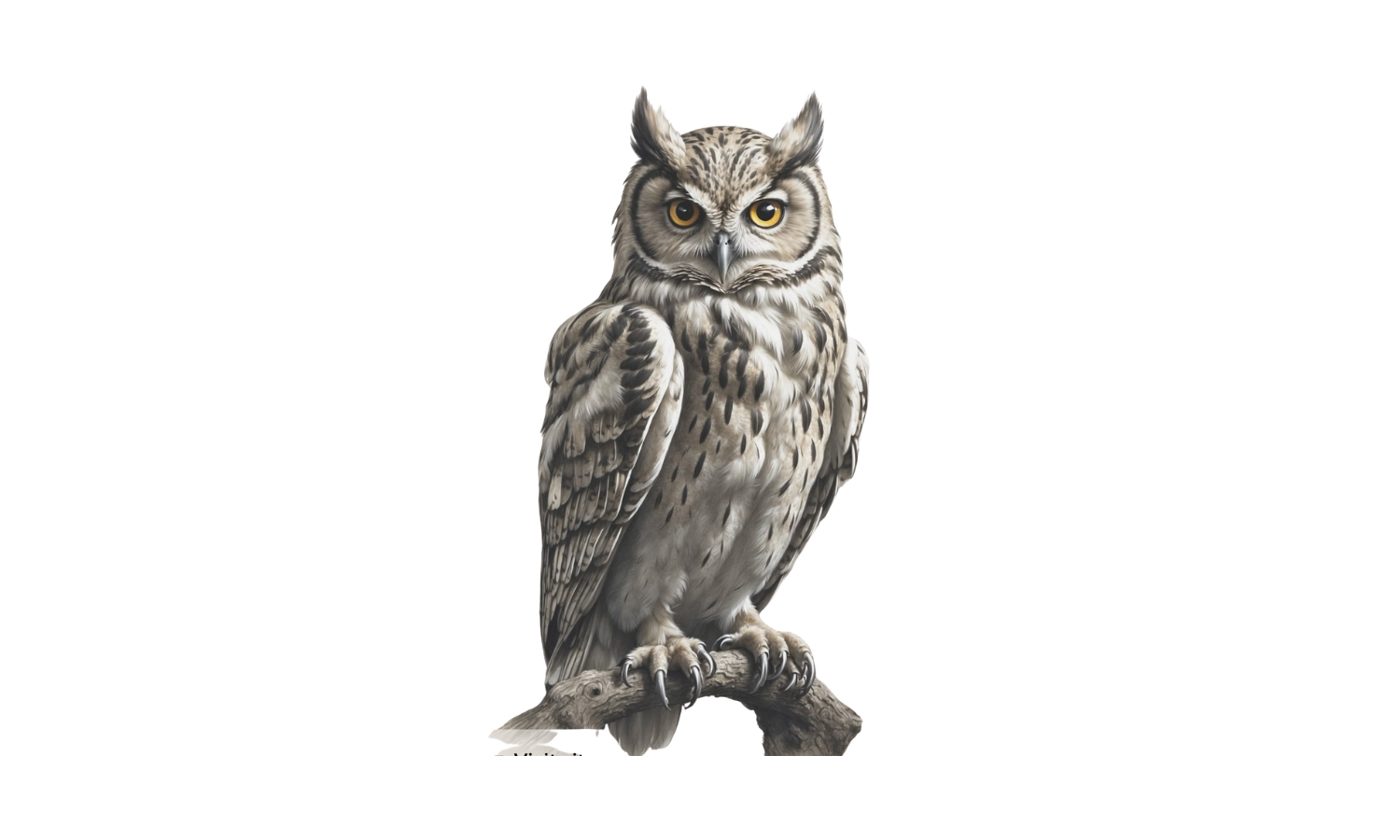
This is owl territory. The owl’s night vision is the capacity to see in darkness without panic; her stillness is listening made form; her restraint is discernment that does not escalate. The owl is Sophia made animal—ordering without domination, receptive without weakness. In Jungian language, this is individuation matured: the psyche no longer seeks victory overshadow but relationship with it.
In the book: “Pagan Meditations” by Ginette Paris gives us a second lens: Paris restores Sophia before demonization, describing a cosmos where logos and eros were companions, not adversaries. This worldview saturates the owl and moon: wisdom as ordering presence, beauty as vivifying pulse. Night, earth, and body are not threats but thresholds.
Paris reminds us that wisdom is relational, not hierarchical—a cosmic order that listens rather than legislates. This principle breathes through the owl’s stillness and the moon’s radiance.
The composition of the crow, owl, and moon makes this logic visible without argument. The crow stands in the foreground—a liminal messenger, the initiator at the shadow threshold.
It breaks the silence and summons courage for descent, echoing the nigredo of alchemical tradition: the necessary dissolution of rigid identifications. The crow is the call to individuation; the psyche’s first disturbance awakes..
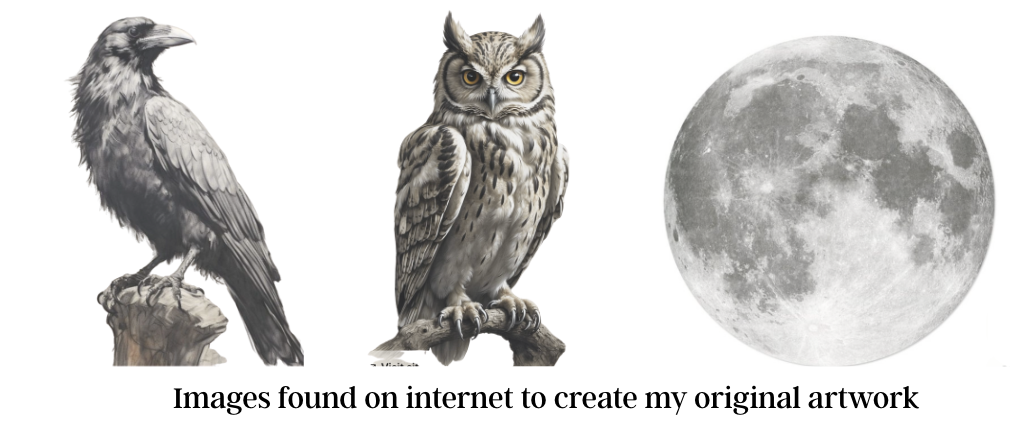
As the art piece for my art project approached completion, the crow image seemed to require one final element—subtle, easily overlooked, yet symbolically decisive. A small, muted skeleton key now hangs nearby, present without being offered. It does not promise access or resolution; it marks only the possibility of entry. The key suggests that descent cannot be compelled—it must be chosen. Knowledge here is not granted from without but accessed inwardly through a willingness to look honestly at one’s own life, body, and psychic history. The key belongs to the threshold itself, and it will turn only in the presence of discernment. In this way, the owl’s restraint becomes essential: she holds the encounter steady, ensuring that what emerges from the descent is neither denied nor weaponized.
The owl waits in the background, prominent yet still—wisdom after descent, containment without force, discernment without spectacle. She does not advance or retreat; she holds. In this sense, the owl embodies a counter‑Lamech posture: where escalation seeks dominance, she refuses it by remaining present. Her gaze does not fix or accuse; it listens. This wisdom is not passive withdrawal but active restraint—an interruption that does not wound, a depth that resists domination without becoming reactive.
As Sophia, the owl represents a form of knowing that emerges only after the shadow has been faced. She does not abolish darkness; she learns to see within it. Her night vision is the capacity to remain oriented when certainty dissolves, to perceive pattern without forcing resolution. In Jungian terms, this marks individuation matured: the psyche no longer seeks victory over the shadow, but relationship with it. Wisdom here is not conquest or control, but the ability to hold tension without turning it into violence.
Behind them both rises the moon—the unconscious field and keeper of cyclical time, holding the rhythm of death and return that frames encounter and integration. Its light does not conquer shadow but makes it perceptible without violating its depth, creating the conditions for transformation without force. As a feminine symbol, the moon is reflective, intuitive, and rhythmic. Unlike the sun’s analytic glare, lunar illumination reveals by indirection, offering contours rather than conclusions. In Jungian terms, this reflected light describes the way unconscious material enters awareness—not through domination, but through receptivity, imagination, and feeling. Its phases—waxing, fullness, and waning—mirror the psyche’s own movement, reminding us that individuation unfolds in seasons rather than through linear advance.
Placed together, this is not “three symbols,” but sequence held in one frame:
encounter → integration → context larger than both. The symbols disclose psychic truth without argument. The composition itself interrupts Lamech’s boast.
Where violence announces itself, the arrangement of the composition contains it. Where certainty performs, the work listens.